
Duo’s new gallery brings Rogers’ hidden 1960s work to light
By Michael Chesnick. September 29, 2026When curators Cooper Colescott and Sam Watts began looking through Barbara Rogers’ old sketchbooks, they discovered something even she had nearly forgotten: a trove of drawings the University of Arizona School of Art emerita professor had made in the 1960s, during her formative years as an artist and painter.
“Our relationship with Barbara inspired her to unearth her work from the past, covered in decades of dust,” said Colescott, a School of Art student. “Sam and I knew right away this would be our first major venture together.”
Now, those largely unseen drawings are the focus of the first exhibition at the duo’s new Colescott Watts Gallery in downtown Tucson. “Barbara Rogers: 1960s Works” opens to the public Friday, Oct. 2, from 4 to 8 p.m. and will be on view through December at 439 N. Sixth Ave., Suite 147.

A young Barbara Rogers and one of her 1960s drawings in the exhibition at the Colescott Watts Gallery. Top photo, from left: Sam Watts, Rogers and Cooper Colescott. (All photos courtesy of Barbara Rogers and Cooper Colescott)
“It’s amazing and almost miraculous to be starring in Cooper’s and Sam’s courageous undertaking of opening a contemporary art gallery in this exciting but turbulent time,” said Rogers, 89.
Miraculous because it was Rogers who introduced Colescott and Watts at her Christmas party in 2024, thanks to her work and friendship ties with renowned artists Robert Colescott, Cooper’s late father, and Sam Richardson, Watts’ late grandfather.
Rogers taught at the U of A School of Art with Robert Colescott, the first African American artist to represent the United States in a solo exhibition at the Venice Biennale in 1997. And she also was a visiting artist at San Jose State University with Richardson, a painter and sculptor whose pieces were composed from layers of plastic to resemble sections of the landscape.
“When Barbara introduced Sam and me, everything just clicked together,” Cooper Colescott said. “We both grew up surrounded by artists and artwork and have been working tirelessly to steward family legacies … so the idea of the gallery felt so natural to us … to celebrate the art and the artists we both love.”
Drawings from a formative decade
Their new gallery’s exhibition offers a window into Rogers’ artistic development as a student and new instructor at UC Berkeley.
“My work from the 1960s is about exploration, finding my voice and constantly going between abstraction and figuration,” she said.
Her path to that period began with a strong foundation in drawing. As an undergraduate at Ohio State University, Rogers learned to focus on the action and movement of the body rather than its details. One unusual course, taught by Professor Hoyt Sherman, trained artists to study a model for brief moments and then draw from memory, even in the dark. “We all learned how to do it,” Rogers recalled.
Barbara Rogers is featured in a recent Arizona Ilustrated profile (watch below).
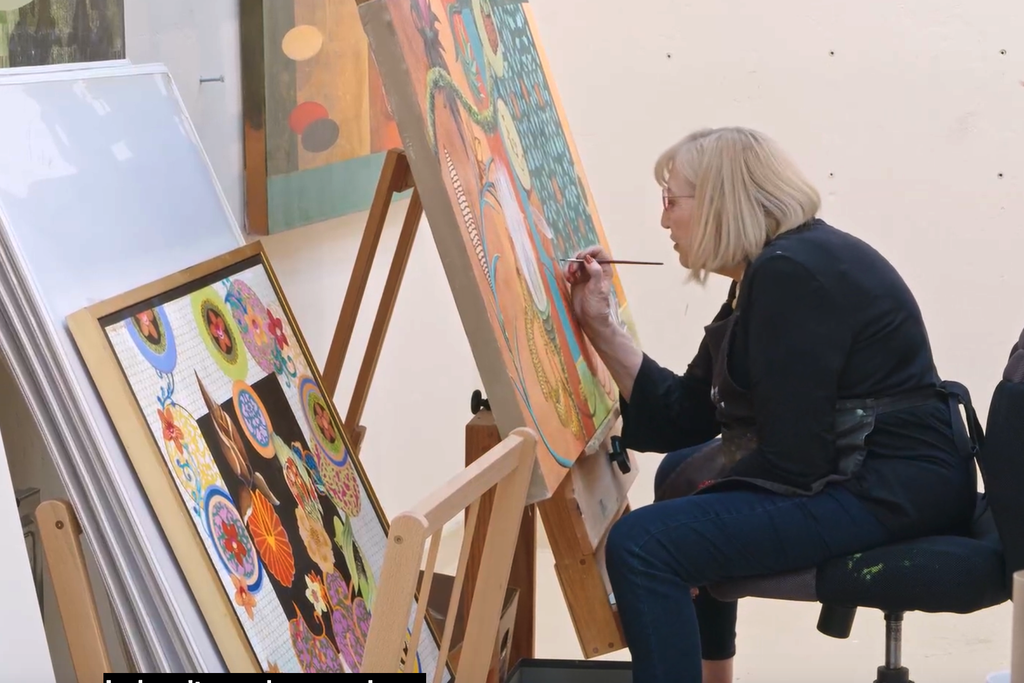
That emphasis on speed and gesture would remain central to her paintings and other work.
After graduate studies at the San Francisco Art Institute, Rogers moved to Berkeley, where professors encouraged her to continue exploring the figure through movement and action. She received the Eisner Prize in painting upon graduation, allowing her to spend a year in New York City studying paintings in the city’s museums and drawing in sketchbooks at her kitchen table.
“I drew my husband, I drew old ladies sitting on park benches in NYC … anything and everything,” she said.
When she returned to the Bay Area, UC Berkeley hired her as an adjunct instructor in painting and drawing. The sketchbooks traveled with her through the years, unopened.
“I never really looked at those early drawings or thought about them until I opened those portfolios for Cooper and Sam,” Rogers said.
The drawings, she said, were made when she was about their ages. “It’s just astonishing to me that these two young men looked at my early work on paper and liked it so much they got it framed and are making that work the focus of their grand opening of their new gallery,” she said.
Cooper Colescott comes home
Born and raised in Tucson, Colescott is the youngest son of Robert Colescott, a painter who tackled subjects of inequality and the human condition through his rhythmic and often manic style of figuration.
Robert, who died in 2009, helped shape the School of Art’s history from 1983 to 1998 as the department’s first Regents Professor, and some of his work is included in the University of Arizona Museum of Art (UAMA).
“My sense of humor, my outlook on life, my qualities as a father, and an artist are all due to my parents and their influences in my life,” said Cooper, whose mother, Colleen Hench, is a Tucson artist.

Cooper and his father, Robert Colescott, whose painting, “Beauty Is Only Skin Deep,” is in the University of Arizona Museum of Art.
After living in Tacoma, Washington, for about 13 years, Cooper returned to Tucson three years ago along with his wife, Jillian, and their children, Hutton and Holly. He decided to pursue a BFA in Studio Art and painting “to push the boundaries of my own artistic abilities.”
Colescott, 40, is now balancing family life, his own art education and the stewardship of his father’s legacy. Along with his brother, Alex, he helps oversee the Robert Colescott estate and recently founded the Robert Colescott Foundation to support art education and continue his father’s artistic legacy.
“Even though I only have time for a class or two a semester I’m feeling incredibly grateful to attend among the current art students, staff and faculty,” Cooper said.
‘Some things are meant to be’
As a child, Cooper remembers Rogers from when his father brought him to events at the university, UAMA and her home and studio. The fact she, Cooper and Watts ended up such good friends goes beyond coincidence, Rogers said.
“You know that old question about timing, luck and the people who come into our lives or re-enter after many years of absence,” she said. “It makes one think about the arbitrariness of everything or the Yiddish term ‘bashert,’ meaning some things are meant to be.”
Robert Colescott helped bring Rogers to the School of Art faculty in 1990 after the two had taught together at the Art Institute of San Francisco. Her connection to Watts is equally rich. Rogers met his grandfather, Richardson, in Chicago in 1975. Both artists were included in the Art Institute of Chicago’s 71st American Exhibition, and their friendship continued through their shared Bay Area art circles.
Cooper Colescott, left, and Sam Watts. “It’s just astonishing to me that these two young men looked at my early work on paper and liked it so much they got it framed and are making that work the focus of their grand opening of their new gallery,” Barbara Rogers said.
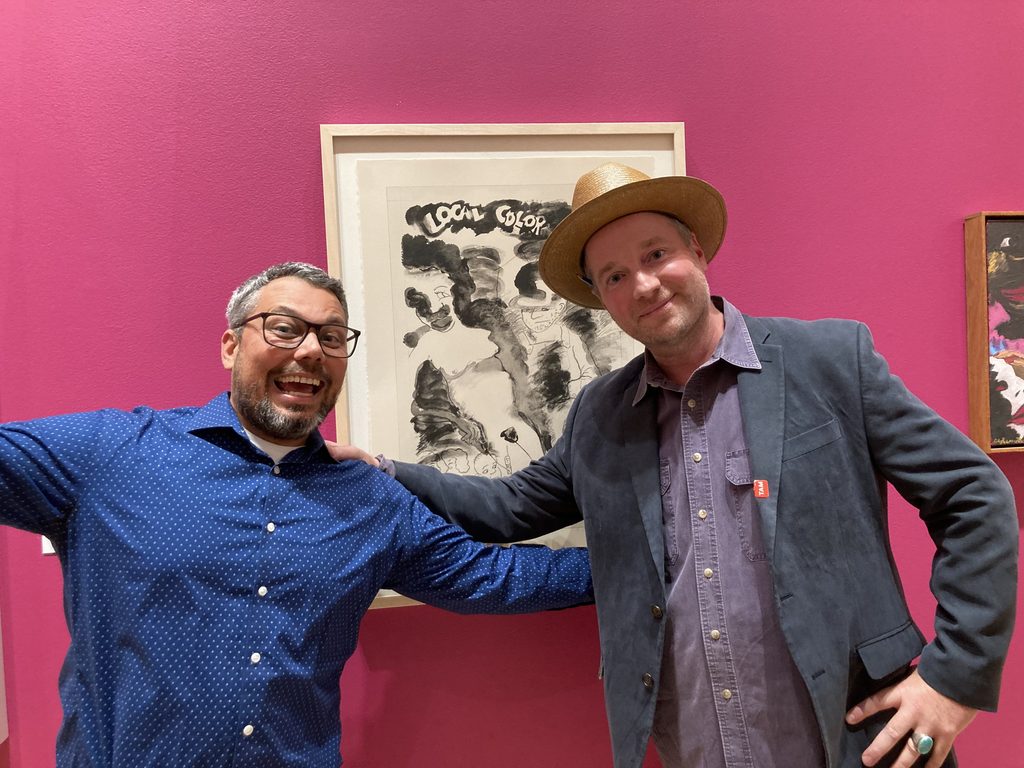
Raised in Northern California’s art community under the influence of Richardson, Watts studied painting at Cornish College of the Arts before spending a decade touring and recording as a musician. He later managed Marfa Book Company and curated exhibitions at various museums to honor his grandfather, most recently at the Anderson Collection at Stanford University,
“From a very young age, my grandfather had me in his studio,” Watts said, “and in the studios of his friends in the Bay Area, who ened up being some of my favorite artists like Nathan Oliveira and Mel Ramos,.”
When Watts moved from Marfa, Texas, to Tucson in 2024 to give his two kids better opportunities and resources, his grandmother, Adrienne Richardson, told Rogers that her grandson would be getting in touch. After Watts visited Rogers’ studio, their conversation quickly turned to the Bay Area art scene.
“I knew he was smart, savvy and grounded in Bay Area art history, like no one I had encountered since I left there to come to Tucson,” Rogers said.
That background made Watts an ideal person to help Rogers document her own experiences. At the suggestion of a longtime friend, Rogers had been considering recording an oral history of her 30 years in the Bay Area. Watts agreed to interview her, and the pair recorded 10 one-hour sessions.
A gallery built on connection
It’s fitting that the new Colescott Watts Gallery is located in the historic Firestone building in downtown Tucson, just steps from Rogers’ studio in the unit next door.
“We are so excited to present ‘Barbara Rogers 60s works,’ a body of work unknown to anyone who knows Barbara as an artist,” said Colescott. Added Watts: “This show means so much to me, as it is about as full circle an experience as life can hand you.”

Two more pieces in “Barbara Rogers: 1960s Works.”
The two curators are also looking forward to future events at the gallery.
“Sam and I both have wonderful relationships with artists, artist estates and collectors who we are so excited to work with to exhibit wonderful works of art from many different ranges,” Colescott said. “We have a couple years’ worth of artist solo exhibitions in the works, featuring artists we absolutely love and committed to, along with many group exhibitions to feature work from many different artists from many different time periods from around the world.”
Earlier, he and Watts featured the work of Jaque Fragua, who spent the summer painting in their pop-up gallery space. “We will continue working with him as we continue our gallery journey,” Colescott said.
As for Rogers, the exhibition brings her own journey as a lifelong artist and educator full circle with a collection of foundational drawings that waited decades for the right people to bring them back into view.
“I am in awe of Cooper and Sam — and their energy and genuine love and knowledge of contemporary art, artists and the history of art,” she said.
Editor’s note: As the University of Arizona School of Art moves closer to its 100th anniversary in 2027, we’re profiling former faculty and students. The Colescott Watts Gallery also will be open Oct. 3. (4-8 p.m.) and Oct. 4 (noon-3 p.m.)


