2023-24 VASE lineup features top artists, scholars

Marking its 17th season, the University of Arizona School of Art’s Visiting Artists and Scholars Endowment series will feature acclaimed artists and educators Vincent Valdez, Kim Cosier, Kelli Anderson and Suchitra Mattai in 2023-24.

The free, hour-long VASE presentations will be held on Thursdays at 5:30 p.m. at the Center for Creative Photography auditorium, 1030 N. Olive Road. Here’s the lineup:

• Vincent Valdez (Oct. 19): Based in Houston and Los Angeles, Valdez is recognized for his monumental portrayal of the contemporary figure. His drawn and painted subjects remark on a universal struggle within various socio-political arenas and eras.

• Kim Cosier (Nov. 2): A professor of Art Education in the Peck School of the Arts at the University of Wisconsin-Milwaukee, Cosier is a member of the activist art collective the Art Build Workers, in which artists and designers partner with community organizations to create artwork that makes visible messages of social transformation.

• Kelli Anderson (Feb. 29): A designer and paper engineer whose work operates in the space between conceptual art, graphic design and tech. Her whimsical books have featured a working paper planetarium, a pop-up pinhole camera, and a paper record player.

• Suchitra Mattai (March 21)The Guyana native explores how memory and myth can unravel and reimagine historical narratives. She works in painting, textile, drawing, sculpture and video to respond critically to colonial histories, particularly those pertaining to her Indo-Caribbean heritage.

“We serve our greatest purpose by providing students with impactful experiences,” Regents Professor Sama Alshaibi said. “The 2023-2024 series features partnerships with the CCP, Racial Justice Studio and UArizona Libraries, allowing us to increase the visibility and impact of the arts on our campus. The VASE program gives students the chance to interact directly with esteemed creative practitioners and thinkers in the field through workshops, seminars, critiques and public lectures.”

In addition to the School of Art and Center for Creative Photography, the series is made possible by the school’s Art Advisory Board Visiting Artists and Scholars Endowment, the National Endowment for the Arts and the College of Fine Arts Dean’s Fund for Excellence.

Go to vase.art.arizona.edu for more details.

2023 MFA Exhibition features 6 student artists

Carrying on a tradition that began in 1970, six School of Art graduate students presented their work in the 2023 Master of Fine Arts Thesis Exhibition in collaboration with the University of Arizona Museum of Art.

The exhibition, with three installations in UAMA and three in the school’s Joseph Gross Gallery, ran from April 15 to May 13 at 1031 N. Olive Road. An opening reception was held April 20 at the school’s atrium.

This annual exhibition, the culmination of the MFA Studio Degree, is presented during a graduate student’s final semester in the three-year degree program. During the last year of their coursework, graduates work closely with faculty to develop a body of original art to present to the public in lieu of a written thesis. The result offers visitors the opportunity to see new, cutting-edge art in a variety of mediums and styles.

“This is the next generation of artists who will be going out and impacting the discipline and thinking about what their next chapter looks like,” School of Art Director Colin Blakely said. “We encourage our students to be bold and experiment and take ownership of their process. This exhibition is a fantastic manifestation of all of those qualities.”

The MFA Exhibition featured installations by Alain Co, Mariel Miranda and Gabrielle Walter in the Joseph Gross Gallery and Emily Kray, Jesus Sanchez-Alvarez and Jandey Shackelford in the UAMA Gallery.

“Each artist in this exhibition took a unique path in their work, demonstrating their research, critical thinking, problem-solving, creativity and ambition,” said Chelsea Farrar, UAMA’s curator of community engagement. “Collectively these works represent the rigor, the quality and the breadth of study of the U of A School of Art.”

VIEW ALL THEIR WORK

ALAIN CO

• Bio: Alain is a Master of Fine Arts candidate in Sculpture. Originally from New Orleans, they received their Bachelor of Arts in Fine Art with a concentration in Sculpture from Southeastern Louisiana University. They have works installed on sites ranging from the Tucson high desert to the Ozark foothills.

• Thesis title: Ever, Always Are

• Artist’s statement: My installation is a response to strong dissociative tendencies. When dysregulated, my grasp of reality becomes fragile and I don’t trust my thoughts or perceptions. Memories become slippery, mutable, and easily influenced. When in that state, working with materials brings clarity to an oppressive fog — if I can touch it, I know it is real. Adaptation has driven me towards object-making in all its forms, and I relate this survival strategy to natural phenomena.

Many studies of Earth systems (ecology, climatology, geology, etc.) use extracted core samples from different substrates, like pencil-thin specimens from living trees or massive cylinders removed from the Antarctic. They are used as analogs for recreating past climate and ecological data. Using condensed layers of debris, scientists can paint pictures of the past, solve ecological mysteries, and posit conditions for the future. The sculpture objects I create are formed through accumulation and reformation.

Each is an experiment that incorporates an array of materials, using a range of techniques. Strata of texture and color are displayed together in an arc with individual arrangements acting as samples of the core materials. Fragments, residue, and debris that is gathered, donated, or remnant from previous projects are assembled, deconstructed, rearranged, combined, dismantled, and assembled again. This body of work and the experience of my being are grounded in the constant bending, breaking, and reforming of matter through living systems on our planet.

• Instagram: @a.co_thealien

EMILY KRAY

• Bio: Emily Kray, is a visual artist working primarily with watercolor and book arts to investigate the complexities and fallacies of memory by manipulating our attachment to nostalgic and familiar forms. He began his artistic career by living and working in Las Vegas and received his BFA from the University of Nevada, Reno in 2020. That same year, he began his MFA at the University of Arizona. He has participated in group shows nationally since 2016 and has had solo shows across Nevada and in Arizona. Since then, Kray continues to make art with a focus on community involvement and volunteer work with a goal to graduate with his MFA in the Spring of 2023.

• Thesis title: You Can Only Turn Left

• Artist’s statement: My installation investigates the blurry state between sleeping and waking where memories fade into dreams, and reality feathers into the fantastic. The expansive nature of our unconscious rivals that of the mysteries of deep space and the depths of our oceans, and reveals to us the limitless potential of our own humanity. Dreams throughout history have been the vehicles for new discoveries, spiritual awakenings, divine interventions, and a place to revisit the absurd theater of life. By untangling and studying my own dreams, I have compiled a personal lexicon of the symbols that appear and reappear to me, referencing my personal truths, absurdity, and the beautiful mundanity of my waking life.

In these artworks, as in dreams, the observer is riddled with the question of agency. The interactive narrative included in the exhibition explores this notion as it simulates the liminal hypnagogic state before one’s body falls asleep. The hallucinations experienced within this simulation force the player to bounce between different states of consciousness while tossing and turning in bed. Both the player and the character lack control in this scenario, thus offering a challenge to be a mentally flexible dreamer and an attempt to achieve lucidity.

The subjects represented in this body of work appear from the black abyss. Dense, inky mist distorts and emphasizes their form. They are hidden and uncovered simultaneously, offering both questions and answers. Each work is a morphing riddle, or a liquid puzzle. By resisting the urge to impose our credulous desires upon these dreamy experiences, these symbols can exist in a realm detached from logic. The subjects within these works offer opportunities for new perspectives, new possibilities, and instances to practice nonattachment to our logical tendencies.

• Website: emilykray.com/emily

• Instagram: @troctopus

MARIEL MIRANDA

• Bio: Mariel lives and works in Tijuana and Tucson, where she is an MFA in Studio Art candidate at the School of Art and the 2021 Marcia Grand Centennial Sculpture Prize recipient. A sociologist and visual artist, she is co-founder and director of the International Festival of Photography Tijuana (FIFT), a feminist platform created for the undisciplined reflection on the image and its current modes of production.

• Thesis title: The dust, or the wind, perhaps

• Artist’s statement : My work presents a speculative fiction installation invoking radical utopias founded in a Science Fiction workshop that I co-hosted with my brother, neighbors and friends in Las Cumbres, my barrio in Tijuana, Mexico. Together we planned how to defend our loved ones against a narco pest and the alien thieves that are causing the running water to dry out in our homes. We challenge the use of our land as a junkyard and undermine the presence of a factory that works for the neocolonialist corporations Tesla and SpaceX — thriving on profit from the old Mars colonization fantasy while relying on extractivist practices and of our manual labor.

In my neighborhood, I have been weaving the tactics of resistance embedded in our collective work and ability to imagine, transform and create with what is available. The years involved in the process of creating a communal library in the front yard of my house as the making of photographs, collages, oral histories, interviews, videos, essays and workshops have allowed me to use art and education as excuses for the mobilization of desire and affective places for the night. In a moment of history, where triumphant narratives depend on our sadness and pessimistic belief in the future’s end, in Las Cumbres — as in many other territories — our fight is for solidarity, joy and life: The South are us.

• Website: marielmira.com

• Instagram: @mariiel.mira

JESUS SANCHEZ-ALVAREZ

• Bio: Jesus is a graduate student in painting & drawing at the School of Art, where he has been a teaching assistant for the “Elements of Drawing” course. His current drawings and paintings attempt to revive historical decorative designs foreign to our fast-paced society through a world he invented consisting of characters who grow ornamented lifeforms through music.

• Thesis title: Embellishment Intimacy

The presence of ornamentation in this work represents the extension of the natural world beyond where it ordinarily grows. As a result, many decorative components take on organic shapes. Ornament in these renditions can be found on the vestments, architecture, wings, trees, plants, and seeds. The large, decorated, egg-like shapes are the seeds which bloom into elaborately designed plants. The nature in these settings grows upon the playing of musical instruments found in the series’ universe.

By combining nature and ornament, two different visual dialogues emerge. The realistic representations of life forms communicate spontaneity, as nature grows unpredictably. On the other hand, the decorative components embody repetition and idealization. Thus, I seek for my work to be a union between realism and idealism, as well as spontaneity and recurrence.

• Artist’s statement: Creating a sense of intimacy with natural forms and ornamentation is the driving force behind my pen and ink drawings and watercolor paintings. My definition of natural forms encompasses plants, human beings, and animals. Studying the diversity of organisms on our planet evokes within me an attraction to fantastical and other worldly imagery, such as hybrid beings. In my view, a hybrid being is a living composite of multiple life forms such as fairies, centaurs, and angels. I view nature as an enchanting place, and I seek to magnify this perception through creating new types of plants and creatures.

• Website: wixsite.com/jernestoart

• Instagram: @j.ernesto.art

JANDEY SHACKELFORD

• Bio: A multimedia artist from Gillette, Wyoming, Jandey received her BFA from the University of Wyoming and studied abroad in Australia, where she focused on making work about the objectification of women.

• Thesis title: Imprint

• Artist’s statement: My work raises questions and sheds light on persistent stereotypes, gender roles and forms of oppression that persist. Specifically, it is a reflective examination of the impact that a space, particularly a home or house, can have on its inhabitants. I utilize a combination of my own footprints and those of others to explore these concepts. The footprints serve as tangible evidence, presence, and memory of the impact that this space has had on those who occupy it.

These large drawings were created through a process that employs bodies, space, interaction and physical manipulation of roofing paper. The material was subjected to a system of imprinting, tearing, arranging, and careful mending with fibers to represent the foundation of a home and the chaos that can exist within it. Through the combination of construction and craft materials, I seek to express the experience of living in a space characterized by a sense of hopelessness and helplessness. The act of creating these drawings represents an effort to transcend the space of sadness from which they were born.

• Instagram: @jandeyshackelford

GABRIELLE WALTER

• Bio: An MFA candidate in Illustration and Design, Gabrielle is a visual artist that makes anything and everything sequential — and work about her relationship with her body, anxiety and womanhood. All mediums are of interest to her, but she mainly uses drawings, cyanotypes, and digital illustration to create her projects. In the past, she has worked in both public and fine art spaces, producing the design for Bill Walton’s chair at University of Arizona basketball games as well as work for Lubbock and Tucson galleries.

• Thesis title: Fireweed

• Artist’s statement: My installation is inspired by a 2022 trip to Juneau, Alaska, where I reconnected with my body through place. An artist book, illustration series and animation incorporate cyanotypes gathered during this journey to tell the story of a fictional protagonist in conflict with herself and nature. As this young woman goes for a walk, she fixates on the beauty of the landscape, spurring a thought spiral about her aesthetic and physical worth in the vastness of her location.

Alaska’s native fireweed (Chamaenerion angustifolium) becomes a catalyst for change as the defeated protagonist finds similarities in her own journey and this weed’s ability to survive. With this work, I was able to ask how the body affects our navigation of mental and physical spaces.

Set to the backdrop of a cyanotype mountain range, I sought to capture the role nature can play in this relationship as it forces us to acknowledge our bodies through physical exertion and witness the beauty found in harsh conditions. Fireweed is an ode to the endurance of the human form and the relationship between femininity, resilience, and the body.

• Website: gabriellewalterart.weebly.com

• Instagram: @gabriellewalterart

Top senior Olander takes her Art History talents to Columbia

Calista Olander traded one canvas — the ballet floor — for another in Art History when she enrolled in the University of Arizona School of Art.

But her love for learning and performing arts didn’t stop there, as she minored in Japanese and mathematics, learned two other languages, helped curate multiple student exhibitions, interned at MOCA Tucson … and studied the history of Korean and Italian cinema.

That explains why Professor Irene Bald Romano calls Olander a “modern-day Renaissance woman” — and why Olander has been named the spring 2023 Outstanding Senior in the School of Art for the College of Fine Arts.

Calista Olander

Olander, who carries a 4.0 grade-point average, has been accepted into Columbia University’s Art History and Archaeology master’s program in New York.

“I’m very excited for grad school,” she said. “I’ll be studying European art between 1700-1900 and working with Professor Anne Higonnet, whose extensive study of Berthe Morisot will aid in my research of Morisot’s contemporary, Mary Cassatt.”

Olander’s first love was dance. She joined the Arizona Ballet Theatre when she was 8 and began teaching ballet, tap and jazz to children and teens when she was 16.

“I absolutely loved teaching and choreographing,” Olander said. “I unfortunately had to stop because of the pandemic, but the experience helped me in my college career … and in my research at the U of A.”

Olander became interested in Art History at Tucson’s University High, where she was a National Merit Scholar. Her Art History teacher’s “passion for the subject made me absolutely love it,” Olander said. “I learned how collections came to be and how museums can improve their exhibition practices to better represent the communities they serve.”

As a University of Arizona student, she continued her research on museums, which culminated in her Honors College thesis about “Decolonize This Place,” a newly formed collective dedicated to challenging issues found within art institutions that affect marginalized communities.

Her adviser, Dr. Sandra Barr, said Olander has “proven herself to have integrity, intelligence, humor and resilience” – in class and in her research on the “Decolonize” group.

“Decolonize This Place is trying to garner attention and protection for Native American art and grave goods,” Barr said. “Calista wrote a very thoughtful account of what the group is and what their aims are.”

Barr, Romano and Gallery Director lydia see nominated Olander for the outstanding senior award.

“Calista is a rare talent of a serious young scholar of art history and mathematics, with outstanding foreign language skills, and a love of the performing arts,” Romano said. “She is a modern day ‘Renaissance woman’ and justly deserving” of the award.

Olander can speak Japanese, Korean and French, and impressed the Art History faculty with “her thoughtfulness, thoroughness and excellence in every aspect of her work: writing, speaking and mentoring other students,” the nominating letter said.

Under see, Olander co-curated the “Donors & Scholars” exhibition in February and served as student gallery manager for the school’s Joseph Gross Gallery, assisting with four exhibitions.

“Calista has been a pleasure to work with and I have enjoyed co-creating exhibitions with her as she expands her curatorial practice,” see said. “She throws herself headfirst into experiential learning opportunities and … has already developed a skilled eye for exhibition design and a keen understanding of how the often-unseen tasks of preparatory and registration work contribute to this overall process.

“She has a bright career ahead, and I’m grateful I was able to work alongside her for a year.”

Olander volunteered at the Museum of Contemporary Art (MOCA) last year and interned there this spring.

In spring 2022, she also studied abroad in Seoul, South Korea, taking an intensive language course and a History of Korean Cinema class, which Olander said “connected well” with two courses she took on campus: Art History of the Cinema, with Anthropology Regents Professor David Soren, and an elective class in Italian cinema.

“It was really interesting to compare film made in Korea, Italy and the U.S., and helped me to appreciate this different art form,” Olander said.

During her final two semesters, she flourished under the guidance of Barr, Romano and see.

“Each of these three people helped me grow, both academically and personally,” Olander said. “They helped me find my path forward and I would not be where I am without them.”

Creating art in Danielle Hunt’s DNA

As the youngest in a family of musicians, dancers, artists and storytellers, Danielle Hunt was a perfect fit for the University of Arizona College of Fine Arts.

The senior is graduating Magna Cum Laude this month with a BFA in Studio Art and Extended Media. She started out in Theatre, Film & Television but changed majors and became one of the School of Art’s most engaging students. Hunt spoke at the Donors and Scholars Exhibition this spring and was a member of the Arizona Arts Equity in the Arts committee.

“I view my role as that of a messenger,” she said about the equity panel, “listening to my fellow classmates, taking note of their concerns regarding equity, diversity, and inclusion, and voicing them in a space where they will be heard.”

Hunt, who’s focus is sculpture, recently answered questions for the School of Art.

Q. Could you tell us a little bit about yourself?

A. I come from a family of five, with my parents and three older siblings (yes, I’m the baby). Both of my parents graduated from the U of A — my father (Craig Hunt) with a degree in chemical engineering and my mother (Cassandra Hunt) with a degree in general fine arts. They actually met here at the university. All my family members are creative in some way: my father is a professional French horn player and pun master; my mother, a dancer and traditional artist of many talents; my sister, a photographer and writer; my eldest brother, a martial artist and storyteller; and my second eldest brother, a musician and special effects guru. Growing up surrounded by creative people, I always felt particularly drawn to the arts and I’m very blessed to have been supported in my artistic endeavors.

Q. You started at U of A with a different major. What attracted you to the School of Art?

A. Having taken film courses throughout high school and enjoying them more than any other subject, I thought it was a no-brainer to enter the U of A as a film major. While all the film classes here were interesting and engaging, I found that they weren’t hands-on enough for me; I needed to be creating things ASAP! I decided to explore Studio Art as a minor and loved the way the classes were structured. I generally felt more productive in my Studio Art classes as well, as physical evidence of my effort would appear in the form of tactile objects, rather than words on paper.

Danielle Hunt

Q. What were your favorite class(es) and project(s) as an undergrad student and why?

A. I would say my favorite class was Beginning Sculpture (ART 287) since it was the class that introduced me to the world of sculpture and allowed me to meet all the amazing faculty and other sculpture-oriented students that I know today. My favorite projects have been those that challenge me as much as they excite me, with my piece “Sensory Maze” being a prime example. “Sensory Maze” was my first ever large-scale installation, and I took tremendous value from being able to create an impermanent environment for others to experience.

Q. You talked about wanting to focus on sculpture now. What is it about this medium that is so intriguing and motivating?

A. Honestly, I would say sculpture just fits my brain the best! Tetris was my favorite video game growing up (still is to this day) because there’s something immensely satisfying about fitting shapes together neatly. Getting to that point of fitting those shapes together neatly, though, involves a lot of problem solving. That’s really all that sculpture is, too: creative problem solving! I love the tactile and sensorial nature of it, being able to really see, smell, hear, taste and feel what it is that I’m creating. Sculpture feels like the truest form of creation to me.

Q. How important is culture and self-identity in your work?

A. I’m finding that culture and self-identity are becoming more and more important in my own work. I tend to gravitate towards exploring abstract thoughts and feelings, many of which have surfaced from my own experiences and personal history, so I hope to incorporate more aspects of my culture and self-identity in my work as a form of self-discovery.

Q. Can you explain the two sculptures you exhibited in the Donors and Scholars Exhibition: “Diverging Timelines Converge” and “Headrest”?

A. “Diverging Timelines Converge” was heavily inspired by Tamara Kvesitadze‘s “Man and Woman” kinetic sculpture. I wanted to explore the idea of sharing a certain amount of time with someone only to be separated before and after that time has passed using perspective. Looking at the sculpture from the “front,” you see two separate figures; looking at them from the “side,” it appears as though they are embracing. The oval base on which they stand leaves some ambiguity as to which direction the figures are facing and questions whether there is a front or side to the sculpture; their timelines are continually converging and diverging depending on how the sculpture is viewed.

“Headrest” became a sculpture where the meaning lay in the process rather than the final product. I had at least five separate wax molds of my face and no clear idea of what to do with them. Eventually, I discovered that the crook of the nose fit rather nicely behind the ear and was able to assemble my own triumphal arch of sorts by fitting three of the molds together. To me, this piece symbolizes tranquility, based on the facial expression and how each face seems to flow into the next. It was certainly an enjoyable piece to work on!

Q. You were an intern for Arizona Athletics. How cool was it to work over there?

A. It’s been great working as an intern in Athletics! When I first started in 2019, there were only three or four interns, me included. Now, it’s closer to 25, so it’s been very special to have seen the internship’s growth from the start. The internship is focused on creative services and media, so most of our work as interns is specific to producing content, creating graphics, and helping with live production during games. I typically help in the control room, controlling the remote camera, queuing up prompts for the video board, or assisting the replay operator. Recently, I’ve been hoping to lean more into producing animated content, so hopefully that’ll be a path I can continue to pursue!

Q. What was your biggest challenge as a student, and how did you overcome it? What was your favorite accomplishment that made you feel happy?

A. One of my biggest challenges as a student, specifically an art student, has been time management when dealing with burnout. I’ve somehow managed to add on more outside projects with each semester, which certainly hasn’t helped. Struggling to keep up with a strict schedule is even more difficult when you’re burnt out and unable to think creatively, and deadlines for finished art projects don’t wait for your burn out to dissipate. The only way I’ve been able to overcome burnout and get back on track with managing my time has been focusing on self-care: taking time to go out in nature, talk with friends, sleep, and take inspiration from the ordinary. It’s been especially helpful and relieving to have understanding professors that can relate to this cycle and will incorporate flexibility into their courses to account for it.

I’d say that one of my favorite accomplishments that has made me feel happy is simply talking to people. Socializing with others has always been a challenge for me, so being able to talk to my peers and other like-minded individuals about things we’re passionate about has been hugely inspiring and encouraging.

Q. What are your goals after graduation? Are you considering grad school? How can you use your art degree?

I plan on staying in Tucson for another year or so after graduating, just to nurture some relationships and give myself time to create more art and expand my portfolio before looking into grad schools. One of my main reasons for wanting to attend grad school, besides continuing to grow my craft, is to have the opportunity to teach and evaluate if I want to consider teaching as a career path. If I decide not to pursue teaching, I imagine I’ll consider attending a trade school for welding or carpentry in order to elevate my current skill set. I’ve had some very exciting opportunities here in Tucson, so it’s possible my plans will be completely derailed and led in an unexpected direction, to which I say: my plan is to go with the flow and see what happens!

• Danielle’s portfolio

Senior’s documentary ‘brings Tucson’s water story to life’

When Tia Stephens needed a local issue to explore for her honors capstone documentary film project, the School of Art graduating senior picked a topic we sometimes take for granted in the desert.

Water.

“Every day I interact with water in the most intimate of ways and yet I had no idea where this water came from and how it was managed,” Stephens said. “This disconnect from our most precious resource is something that I’ve noticed all around me, and so I want this film to serve as a way to reconnect people with water.”

“Every Last Drop,” Stephens’ feature-length documentary, explores Southern Arizona’s water practices and policy. A free screening of the film will be held Tuesday, May 2, at 7 p.m. at The Loft Cinema, 3233 E. Speedway.

Stephens blended her skills as a Studio Art student in Photography, Video and Imaging along with her multimedia journalistic skills gained as an editor at the Arizona Daily Wildcat.

For the past 18 months, Stephens collaborated with film students, obtained grants, consulted water and hydrology experts, and executed a data research project to bring “Tucson’s water story to life,” she said. In the film, experts include a faculty and student, and officials from Tucson Water, the Senora Project and the Apache Nation.

“Water must be priority number one for us in Arizona,” Stephens said, “and currently it’s clearly not. I think most people are aware of how important water conservation is, but … we need to bridge the separation that exists between us and the planet and stop seeing it as merely a resource to use.”

Stephens grew up in Flagstaff, speaking out on climate issues at the Arizona Capitol as a senior in high school.

It also helps that Stephens has a keen sense of how government works as a Political Science double-major in International Relations in the College of Social & Behavioral Sciences.

“With her high quality of work, a 4.0 GPA and her leadership across activities, Tia is doing exceptional community-engaged research on environmental issues,” said Marcos Serafim, her capstone project adviser and a School of Art assistant professor.

“Tia’s exceptional creative practice is informed by her journalistic agency and her knowledge of world politics,” he said, “frequently employing investigative strategies to generate poetics and artwork about relevant social issues.”

Serafim “guided me every step of the way,” said Stephens, who will graduate Summa Cum Laude with honors with her Bachelor of Fine Arts degree.

“He gave me the space to dream big and be ambitious and connected me with the resources I needed to get the project running,” she said. “I have learned so much under his mentorship and am forever changed as an artist because of it.”

After graduation, Stephens has a summer internship with AmeriCorps as a videographer.

“My immediate plans are to stay in town, take a much-needed rest, and do some self-discovery in order to figure out my next steps as an artist,” she said. “Eventually, I plan to pursue an MFA, but first want to gain some work and life experience.”

Panama inspires grad student Arias in her art, filmmaking

Born in Costa Rica, Jacqueline Arias was adopted by American parents and moved to the Panama Canal Zone at age 4. While she only spent three years there before moving to rural Ohio, the experience made a profound impression on the artist, independent filmmaker and educator.

Now a University of Arizona School of Art graduate student, Arias is working with artisan women from Panama — the Guna people — to make traditional mola quilts that incorporate her personal designs and reference borders, military presence and the canal infrastructure.

Jacqueline Arias

Arias held her first solo exhibition, “Mola: Truth Maps,” at Nogales’ Hilltop Gallery in March 2023. Through videos, prints and VR, she activated the molas as visual and aural maps — lived maps — that collect and narrate the lived experiences of the people of Panama.

In September 2022, her video “Panama Narratives,” which incorporates the mola mythology, was shown at the Arizona Underground Film Festival in downtown Tucson. The short documentary coincided with National Hispanic Heritage Month, which also celebrates Latin America heritage.

Arias’ video explores her childhood experience, the U.S. intervention in the Canal Zone area and the relationship between its residents and the Panamanian and indigenous Guna people.

“I’m drawn to the Guna matriarchal society, where the molas are worn by women as protection, a tradition drawn from the story of a young woman who finds enlightenment through overcoming obstacles,” Arias said. “Through enlightenment, she shares the gift of protection and knowledge with other women of her tribe.

“In exploring how this mythology speaks to my personal experience — I am returning to my indigenous roots to find healing and knowledge and re-examining my Latinx experience of dislocation.”

The Guna people are autonomous from Panama and have fought to maintain their land, heritage and governance. Arias’ designs deviate from traditional mola subject matter, which is usually apolitical, she said.

“I’m interested in the mola because the materiality represents a material embodiment of indigenous cosmology,” Arias said. “They use reverse applique technique with fine needlework that stitches together multiple layers and colors of fabric. These layers represent a spiritual labyrinth, which can trap evil spirits within their patterns.”

Arias said she’s begun to incorporate her mola panels into printmaking to “talk about invisible labor, constructed borders and U.S. occupation.”

A second-year MFA candidate in the interdisciplinary program, Arias was selected for the Border Lab Graduate Fellowship program by the Confluencenter for Creative Inquiry, a $10,000 award possible with funding from the Office of the Provost and University of Arizona HSI Initiatives.

She studied photography at Parsons School of Design, experimenting with video art and performance work. Her work addresses the invisible social barriers in society and the feelings of cultural detachment they cause, she said.

Arias is enjoying her classes and hopes to graduate in 2024.

“I’ve learned so much in the short time I’ve been here,” Arias said. “I The instructors are just as nurturing as they are challenging. My goal is to soak up as much knowledge as I can while I’m here.”

• Jacqueline Arias’ website

Doctoral candidate Chavez named Tyson Scholar

Ricardo Chavez, a University of Arizona School of Art doctoral candidate in Art History and Education, has been named a prestigious Tyson Scholar in American Art for the fall 2023 semester at the Crystal Bridges Museum of Art in Bentonville, Arkansas.

Chavez will spend the 15-week residential fellowship doing research for his dissertation, “The Lost Utopian Classroom: Radical Pedagogies in American Art.” The project involves the intersections of art, education, and activism in American art and the legacies of the social movements of the 1960s as they impact artistic practice today.

Ricardo Chavez

“The biggest thing for me is the feeling of reaffirmation for both myself as a scholar and for the value of the research I am conducting,” Chavez said. “The whole experience of being a visiting scholar at such a well-renowned American art institution feels incredible to me.”

Established in 2012, the Tyson Scholars Program in American Art​ has supported more than 70 scholars, attracting national and international academic professionals. Crystal Bridges, founded in 2005 by the Walton Family Foundation, has a collection that spans five centuries of American art with 3,000 paintings, works on paper, sculpture, photography and new media.

“We believe your proposed project has the potential to advance the understanding of American art, and we look forward to welcoming you to the fellowship program,” Cyrstal Bridges executive Mindy N. Besaw told Chavez in his invitation letter.

For his “Lost Utopian Classroom” dissertation, Chavez plans to use his residency “as an opportunity to immerse myself in the museum’s social and community engagement programs that demonstrate the kinds of pedagogical and socially engaged art practices that are central to my dissertation work.”

Chavez grew up in Merced, California, in the heart of the state’s rural Central Valley.

“My location, coupled with being the son of immigrant parents who never entered into higher education, meant I had little exposure to art until I entered college,” Chavez said. “After taking some introductory courses, I really got into the subject when I took a course on contemporary art history and became fascinated with the diverse artistic voices and their creativity in expanding the definition of art in the present.”

Chavez earned his B.A. in Art History from California State University-Sacramento in 2011 and his M.A. in Art History and Visual Culture from San Jose State University in 2018.

He chose the University of Arizona School of Art to pursue his doctoral degree to work with Professor Larry Busbea, his adviser who specializes in design and art of post-war United States and Europe.

“I also was drawn in to earn my minor with the Art & Visual Culture Education program, due to its strong focus on using art education for social engagement,” Chavez said.

“My studies have thus pushed me to find ways to bridge the gap between what the fields of art history and art education have to offer one another,” he added. “Doing so while finding my own voice as a scholar and educator have been both the most challenging and rewarding aspects of my time here.”

Chavez, a graduate teaching assistant for the School of Art, said students interested in Art History and Art & Visual Culture Education should “expand the field.”

“Push it beyond its disciplinary boundaries,” he said. “That is what art history needs the most. It is not just a matter of studying creativity, it is also about being creative while doing so.

“Begin by identifying what interests you the most within the field, whether it is a movement, a time period, a medium, or a theme, and then try to build on that,” Chavez continued. “Try to build on the way art history perceives it, and eventually you might find a new and unique way of doing so that the field has yet to consider.”

Mosley showcases social justice storytelling

Before bringing her storytelling skills to the University of Arizona School of Art’s graduate program, Semoria Mosley found out just how impactful her photography could be during a social justice reporting project for the San Diego Union-Tribune called ­“____ while Black.”

Mosley amplified the voices of seven Black Americans who faced subtle and overt discrimination and exclusion in San Diego after interviewing more than 300 people. She told her editors, “I have hopes that the photographic art I create will give the invisible the superpower of being seen and probe the ones who never saw them to ask themselves, ‘How long have I ignored this voice?’”

Semoria Mosley’s project for the San Diego Union-Tribune

Her hopes were answered.

“When it was published online and in print, I started getting calls and emails from San Diegans who felt moved by the work — it caught me by surprise honestly,” Mosley said. The seven profiles online contained film and digital photography, along with audio clips from her interviews.

She was one of six young journalists from diverse backgrounds selected to participate in the 2019 project, which won national and local awards. She grew up in Columbia, South Carolina, which has a 40 percent Black population compared to 6 percent in San Diego.

Mosley, 26, is pursuing her Master of Fine Arts in Photography, Video and Imaging after earning her B.A. in Mass Communication and Media Studies from Claflin University in South Carolina. “While emphasizing the Black American experience, my work is a portal to multicultural understanding,” she writes on her LinkedIn page.

She answered questions for the School of Art during February’s Black History Month.

Q. How did your Southern roots help you become a better photographer and storyteller?

A. Being from the South taught me that there is a truth that’s subjective (and pretty objective in my opinion, but y’know) to my lineage and a truth that is subjective to their lineage. It inspired me to look beyond the normal bounds of truth and storytelling to see where the proof could exist; beyond devices like bondage, history, racism and representation.

Q. How important is authenticity and preserving cultural identities in your work?

A. Preserving cultural identities in my work is imperative because it assists me in being resistant to colonial constructs and more uplifting of the “discredited way of knowing that discredited people often have” (to quote Toni Morrison) — which I find in myself. It’s the permission I’ve given myself to fully immerse in the actuality of my experiences. With representation on everyone’s plate, at the dinner party where all men are created equal, I have hopes that outside the smoke and mirrors, my work can serve as reference to a life truly lived — in all of its subjectivity, nuance, and vision.

Q. You attended the same middle and high schools as Dylann Roof, convicted in the 2015 racist slayings of nine members of a Black South Carolina congregation. How does that reminder affect you and your work?

A. It reminds me that Black, Brown and other colored communities are in close proximity to racists whose ideals can manifest in extreme ways and not even know it. In creating work, I realize I have no time to be slight in my expression as an artist; nor do I have time to explain. Walking on eggshells is a disservice to the resilience of my people. I think we’ve been cornered into being submissive to the voice that is not ours for far too long. My voice is my gift, so I work it as such.

Q. How did your Social Justice reporting project with the San Diego newspaper come about? What was the experience like?

A. I applied after my photo editor at the San Diego Union-Tribune suggested it. Of course, there weren’t any guarantees, but I’d just done 10 portraits for their front-page Sunday story — about a week after George Floyd was murdered. The editor knew I was eager to do more print work and that I would deliver, so it was a good opportunity. Working on that project solidified the passions I have for documenting, community and creating. I worked on it for about six months.

While I was excited, I was hesitant to speak about a community I had only been in for a year. Careful not to impose my idea of Black, my identity politics on to them, I asked the Black community what they dealt with. I interviewed anybody who considered themselves Black and was a native of San Diego — making exceptions for individuals who migrated to San Diego and/or lived there 10-plus years.

After listening to 300-plus people’s experiences, I picked seven to express the recurring sentiments I heard of Growing up / Birthing / Speaking up / Identifying / Fostering / Parenting /  being Homeless … while Black. It was hard to meet the subjects because Covid was extremely new, we were about four months in. The subjects changed often due to feelings of health anxiety, targeting from the (police department) and not wanting to lose their jobs — I understood. I’d like to do a shout-out (to the subjects) — Mikey, James, Ms. Shelley, Eryn, Billy, Ms. Ebony, Diamondz and Ra — for lending their stories and voices. The community appreciated it. I appreciated it, much gratitude. …

I spoke on San Diego’s NPR about it which made more people engage with it. It made me more confident. Now, I have community in pockets across San Diego, that are just one call away if need be. I also keep up with what’s going on, always still there to lend a hand.

Q. What attracted you to attend the MFA Photography, Imaging and Video program at the School of Art?

A. friend of mine (alumna Nassem Navab, MFA, ’19) who I met in San Diego suggested it to me. She was a graduate of the PVI program and knew it’d benefit me. I had always wanted to go to art school and the opportunity presented itself as organically as it could. The care from the School of Art and PVI’s welcoming arms, it felt right — and you always do what feels right. I’d like to give a shout out to Nassem; you’re a real one!

Q. What project(s) are you working on now?

A. I’m working more with the moving image, making myself the subject, challenging my visual language. I’m definitely in an experimental phase, but I enjoy.

Q. What are your career goals after you graduate?

A. It’s too early to tell. Circle back in 2025!

Grad student Walter surprises Walton with repainted chair

Basketball television analyst Bill Walton is a huge Grateful Dead fan. As luck would have it, the University of Arizona School of Art graduate student tasked with repainting his special McKale Center chair also shares his love for the eclectic rock band.

“I’m a big fan, so I originally did a design where it was all Grateful Dead,” said Gabrielle Walter, an MFA candidate in Illustration and Design. “But then I did some research on Mr. Walton, and I realized he also loves the Sonoran Desert and Tucson.”

Gabrielle Walter chats with Bill Walton via Zoom. Photo by Mike Christy / Arizona Athletics

So Walter incorporated more desert artwork on the seat and a small university logo on the back, while still including two small skull and lightning bolts – the band’s iconic logo – on the front. The lettering on the back, with the band’s font, simply says “Bill’s Chair.”

“I wanted to make sure the design was a culmination of all the things near and dear to his heart,” Walter said.

The finished product left Walton almost speechless on Jan. 7, when Arizona Athletics presented the yellow chair to Walton before the men’s basketball game against Washington State. Walter, who goes by “Gabi,” attended via Zoom and chatted with Walton as School of Art Director Colin Blakely and Assistant Director Karen Zimmermann looked on along with University of Arizona President Robert Robbins and Director of Athletics Dave Heeke.

Walter’s design incorporates Grateful Dead logos and Sonoran Desert artwork.

“Oh, my. Look at this chair,” Walton said after it was unveiled at center court. “You’re incredible, Gabi. How did you know I like all this stuff?”

The new paint job idea came out of a meeting between College of Fine Arts Dean Andrew Schulz and Matt Ensor, assistant athletic director for communications.

“Obviously Bill is an iconic fixture in all walks of life and a champion of the University of Arizona,” Ensor said. “Once the idea came out in conversation with Andy, it was off and running.”

Walter ran her design ideas by Blakely, Zimmermann and Arizona Athletics. Walter sandblasted the chair to begin with, then had it finished with a protective coating afterward.

“When you get artists involved like Gabi, this is how cool you chair can look,” Blakely told Walton.

“Yes, I now have an ultimate destination (on press row),” said Walton, admiring the chair, which will stay in McKale.

“Bill’s Chair.” Photo by Mike Christy / Arizona Athletics

The tall chair makes the 7-foot Walton seem even more imposing. A member of the Naismith Hall of Fame, the center led UCLA to two NCAA titles and helped the Portland Trail Blazers and Boston Celtics win NBA championships in a stellar professional career.

His career took a toll on his body — Walton has had nearly 40 orthopedic surgeries, including several on his back — so he asked the University of Arizona years ago to order him a plain gray metal chair that helped his posture during the games.

To spruce up the chair, the School of Art ordered some enamel paints, and “I was lucky enough to get to do all of the detail work by hand,” Walter said. “A lot of the imagery is inspired by the Saguaro National Forest and the plants found there.”

Walter grew up in Houston and listened to her family to stay in Texas for her undergraduate degree, which she earned at Texas Tech. She loved Lubbock, creating a mural there, but said she was “ecstatic” when she was accepted into the University of Arizona School of Art.

Gabi Walter designed the bandanas to welcome new art students last fall. 

Her partner, a graduate student in Omaha, Nebraska, also is a huge Grateful Dead fan. Walter plans to move to Omaha to be with him after graduation in May.

Walter is a graduate assistant for the School of Art, teaching studio art classes for First Year Experience students.

“I really love teaching,” Walter said. “I also worked with high school students as an undergrad at Texas Tech. I realized how much a difference you can make as a teacher.”

She certainly made an impression with Walton.

“I’m the luckiest guy in the world,” he said. “Spectacular job, Gabi. Empty the Thesaurus. You did it right here.”

Walton added: “I need my chair, and now I have a special one, and I can beam ever more proudly.”

“I’m happy to do anything for a fellow Deadhead,” Walter said.

Outstanding Senior: Amanda Lipp’s passion for art history ‘boundless’

Amanda Lipp made no secret about it. After taking her first Art History class in high school, “I quickly realized that I wanted to study the subject for the rest of my life,” she said.

Fortunately for the School of Art, she decided to pursue her passion at the University of Arizona – and now she’s unlocking mysteries of 18th century Mexican pottery and researching discrimination that still exists 50 years after Linda Nochlin’s 1971 groundbreaking essay, “Why Have There Been No Great Women Artists?”

Lipp, who just graduated, received the fall 2022 Outstanding Senior Award from both the entire College of Fine Arts and the School of Art for her devotion to scholarship and art communities through her museum work, volunteerism and leadership.

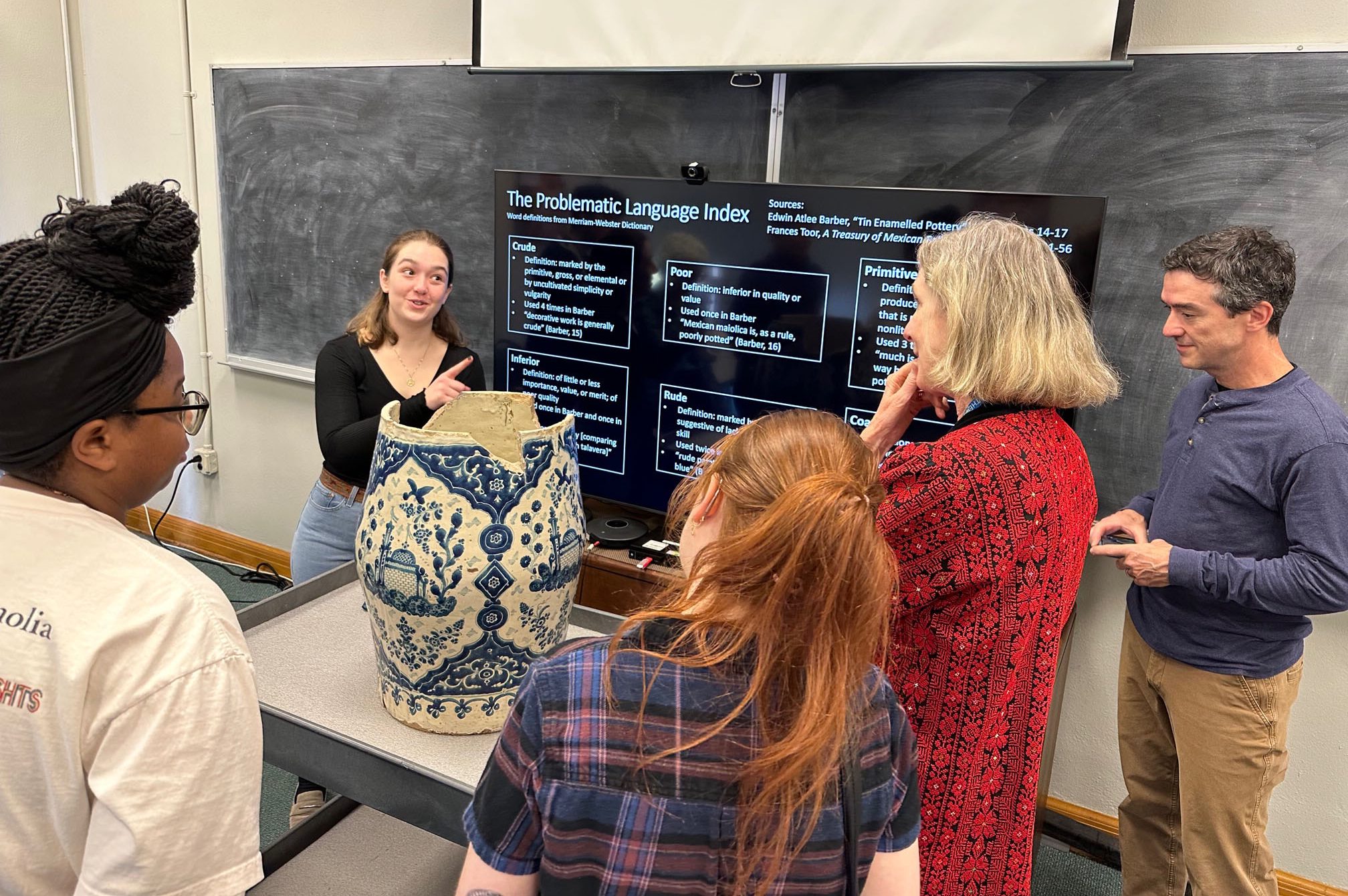
At a recent presentation at the Arizona State Museum on campus, Lipp enlightened an audience of peers, faculty and the public about the museum’s 18th century Mexican talavera jar – and how the earthenware has been misunderstood historically.

Amanda Lipp and talavera jar

“What makes Amanda so special is that she genuinely enjoyed tackling an object that was not going to reveal its secrets easily,” said Professor Stacie Widdifield, who oversaw Lipp’s project. “She not only literally looked at the jar from all sides, that is materially, but also in the context of the ASM collection and then in the broader art historical and museum context.

“Her joy and enthusiasm for the project was boundless.”

Some of that joy came from Lipp’s determination to learn more about her heritage.

“Part of my family is Mexican, but I’ve always felt a kind of disconnection from that culture,” Lipp said. “Connecting to talavera and to these deep parts of Mexican culture impacted by colonialism and many cultural shifts has been a way to connect back to myself and my family.”

Lipp grew up in Tucson and attended University High, where she was mentored in Art History by Whitney Sheets.

At the University of Arizona, she majored in Art History and minored in Art and Visual Cultural Education. She held internships in Tucson’s Museum of Contemporary Art and the Phoenix Museum of Art, where she assisted in the curation and installation of the popular 2018 exhibition, “In the Company of Women.”

The Phoenix all-woman exhibition “got me thinking about tokenism, exceptionalism, and the idea of genius,” Lipp said. “I thought it was interesting that the Linda Nochlin article so many curators referenced — ‘Why Are There No Great Women Artists?’ — seemed to contradict having these ‘all-women’ exhibitions.

“Systemic oppression and discrimination are an ongoing battle, and part of that battle is researching and uncovering those systems,” said Lipp, who wrote a paper on the subject for Professor Irene Romano. “I want to continue research on this project in the future, because I think it is important to do research based on real world issues.”

In spring 2022, Lipp also interned at the University of Arizona Museum of Art, where she developed a research guide for women artists in the collection, facilitating hands-on activities at community events, observing gallery tours and providing feedback on the tours.

She was awarded the School of Art’s Undergraduate Schaeffer Prize in the Art History Research Paper Prize competition in spring 2022 for her analysis of the talavera jar in Widdifield’s class. Lipp presented her research at the first Arizona Latin American Studies Symposium.

For her final paper in Professor Carissa DiCindio’s museum education class, Lipp focused on engaging people with art outside of museum spaces, holding a “Kunst” event at her home and discussing ways museum education practices could be used to garner interest in artist Gustav Klimt among her guests.

“Amanda dives into projects with creativity and focus,” DiCindio said. “She is definitely a student who really loves the work she is doing.”

Lipp restarted the school’s Undergraduate Art History Club and became its president, planning events to raise interest in and awareness of art history. She also served as a grant panelist for the Arts Foundation for Tucson and Southern Arizona.

In Professor Larry Busbea’s classes, she conducted probing research on institutional critique and psychedelic graphics from the 1960s.

“Out of more than 30 years of undergraduate teaching, Amanda stands out in my mind as one of our Art History program’s most informed and mature students,” Professor Paul Ivey wrote, “exhibiting creative innovation, intellectual vitality and rigor, and a gregarious drive to learn and integrate what she learns with her goal to become a professional art historian.”

Lipp’s ultimate goal, indeed, is to become a museum curator or educator, preferably for Latin American art. She’s planning on pursuing a master’s in Art History and a doctorate in either Art History or Art Education.

“Right now, I have it planned out, but who really knows what the future holds,” said Lipp, who has future trips schedule to Europe, Mexico City and Puebla, Mexico.

“It turns out, I love to teach and make art accessible,” Lipp added. “The School of Art really provided the perfect place to interweave my dual interests of people and art.”

I fell down some stairs

I fell down some stairs

Lyle Emmerson Jr.
What Do You See?

What Do You See?

Utvista Galiante
Floral Arrangement

Floral Arrangement

Janessa Southerland
Half Off Special

Half Off Special

Wilbur Dallas Fremont
Tailgate Party

Tailgate Party

Roger Masterson