Gwilliam named CFA outstanding senior

For Nuala Gwilliam, art began before sunrise.

As a toddler newly moved from Massachusetts to Tucson, Gwilliam often woke up hours before the rest of her family. To keep her occupied, her parents left out crayons, paper and snacks beneath the kitchen table.

“I’d probably attribute the beginning of my ‘artistic career’ to when I was 3 or 4, dealing with jet lag,” Gwilliam said. “So, from a toddler scribbling at 5 a.m., to an awkward middle schooler making comics in the margins of my homework, to a high schooler flourishing in art club, to being here at the University of Arizona, art has always been in the forefront of my mind.”

Nuala Gwilliam

Now, years later, she’s inspiring young artists to find their voice and is being honored as the College of Fine Arts Outstanding Senior during the May 17 CFA Spring Graduation Convocation in Centennial Hall at 2 p.m. After graduating with a BFA in Art & Visual Culture Education, Gwilliam will start a job teaching art at Catalina High Magnet School in August.

A record of academic excellence

In their nomination letter, School of Art Associate Professor Carissa DiCindio and Professor Ryan Shin described Gwilliam as “one of our strongest recent undergraduates in AVCE,” praising her exceptional academic record, leadership and commitment to youth arts education.

Academically, Gwilliam maintained a 4.0 GPA at the University of Arizona and earned Highest Academic Distinction in 2024 while repeatedly appearing on the Dean’s List with Distinction. Faculty noted her professionalism, thoughtful participation and ability to combine educational theory with practical classroom experience.

“She developed a solid understanding of the principles and procedures of art education and strengthened her instructional and classroom management skills through practical teaching experiences,” DiCindio and Shin wrote.

That experience has taken many forms. Gwilliam worked as a “Chugim” art instructor at the Tucson Jewish Community Center, where she taught weekly art classes for groups of 20 to 30 elementary school students. Her lessons centered around themes such as kindness, gratitude, creativity and persistence.

She also interned with Groundworks, a community arts nonprofit dedicated to creating safe and accessible creative spaces for youth. There, she facilitated public open studio hours, developed lesson plans, volunteered at exhibitions and events, and assisted with promotional design work.

Learning from a fellow School of Art graduate

One of the most influential experiences of Gwilliam’s undergraduate career has been her student teaching placement at Tucson Magnet High School under mentor teacher Elizabeth Denneau, herself a 2018 School of Art BFA graduate in AVCE.

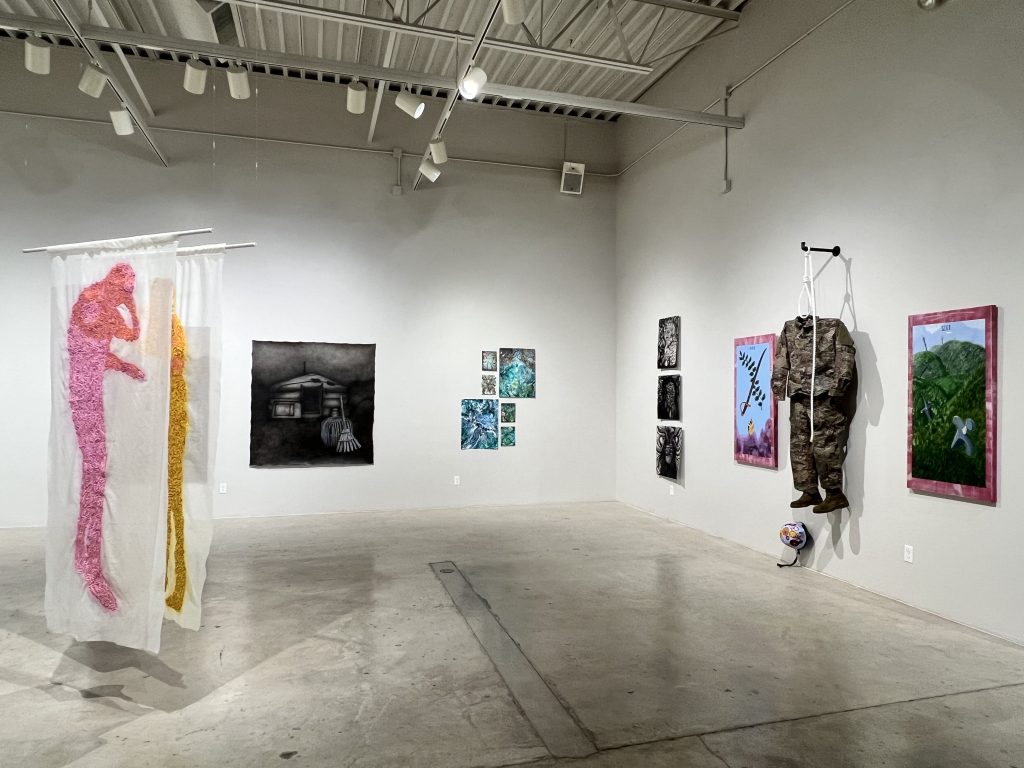
Nuala Gwilliam’s BFA installation, “Intersection,” mixed media, 2026

For Gwilliam, the experience has offered a firsthand look at the kind of educator she hopes to become.

“Student teaching at Tucson High has been an amazing experience,” she said. “While studying how to teach is great, actually doing it is an entirely different rodeo.”

She described her students as creative, funny and inspiring, but emphasized the impact Denneau has had on her development as a teacher and artist.

“I truly couldn’t be having the experience I am without Elizabeth Denneau, my mentor teacher,” Gwilliam said. “Her experience as both an artist, and an educator of high school and college students has given me incredibly valuable perspective and insight. She’s truly helped me solidify the teacher I want to be, and I can’t thank her enough.”

The mentorship has also reinforced the strong connections between the School of Art and Tucson’s broader arts education community, with one generation of graduates helping guide the next.

Faculty members say Gwilliam’s teaching philosophy centers on making creativity accessible while encouraging self-expression and confidence.

“I really enjoy watching the cogs turn in someone’s head as they realize something new, or hone a new skill, or express something in a way they haven’t before,” she said. “Teaching art really feels like the pieces falling into place for me.”

Building community through art

Alongside her educational work, Gwilliam has also built a strong artistic practice of her own. Faculty selected several of her projects for exhibition, and this spring she participated in the 2026 BFA exhibition for 2D Studies with her mixed-media installation, “Intersection.”

Gwilliam, who did commission-based illustrative work all throughout high school and into college, is interested in design but also enjoys traditional art. “I’ve worked a lot in mixed media. I love finding new ways to communicate through materials as well as imagery,” she said.

“With my time in both the Illustration, Design & Animation track as well as Art Education, I’ve been able to meet artists with many different disciplines and talents,” she said. “I can’t credit the CFA enough for the impact it’s made on my artistic development, my perspectives on art education, and my personal life and community.”

Though her résumé is filled with accomplishments, some of Gwilliam’s favorite memories are rooted in quieter moments of connection.

She recalls a late night during her freshman year in sculpture class, when she and several classmates stayed in the studio working toward a deadline. Covered in paint and insulation foam dust, the exhausted group was suddenly offered leftover catered food from another campus event.

“I don’t think better words have ever been spoken to a group of hungry 18-year-olds covered in paint,” she said. It was the best food I’d had in weeks — little steak kebabs, brussel sprouts and dessert tarts. All woefully underdressed for the event, we filled our paper plates and laughed at how lucky we were.”

Moments like those helped define her undergraduate experience — one shaped by collaboration, mentorship and community. “I was making friends and art and eating good food and listening to great music, all at once,” she said.

Gwilliam credited Dr. DiCindio and Dr. Shin for playing “a big part in my development of my educational skills and passions.” But she also expressed gratitude to graduate instructors, including Hanan Khatoun, Trent Pachon, Drew Grella and Dylan Hawkinson, as well as faculty members Angie Zielinski and Cerese Vaden for encouraging her artistic growth and supporting her through challenges.

A new chapter at Catalina Magnet High School

After graduation, Gwilliam will begin a full-time position teaching art at Catalina Magnet High School, marking the beginning of her professional career as an educator in Tucson.

The opportunity represents a major milestone for Gwilliam, who hopes to continue building inclusive, community-centered art spaces for students while also developing her own creative practice.

“I see my graduation as the beginning of so many new potential opportunities,” she said.

Alongside teaching, Gwilliam plans to continue freelance illustration work, pursue graphic design studies and stay active in Tucson’s arts community through museum and nonprofit volunteer work.

“I have one life, and I intend to fill it with as much art as I can.”

Caballero named CFA outstanding graduate student

Growing up in Mexico City, Andrés Caballero made sure to cherish dinnertime with his parents and two older brothers — no matter how busy or tired they all might be.

“It was the one moment we shared each day,” he said. “For me, and for many families, the dining room is a cornerstone of identity. It’s the space where conversations unfold, stories are told, and memories take root.”

Andrés Caballero

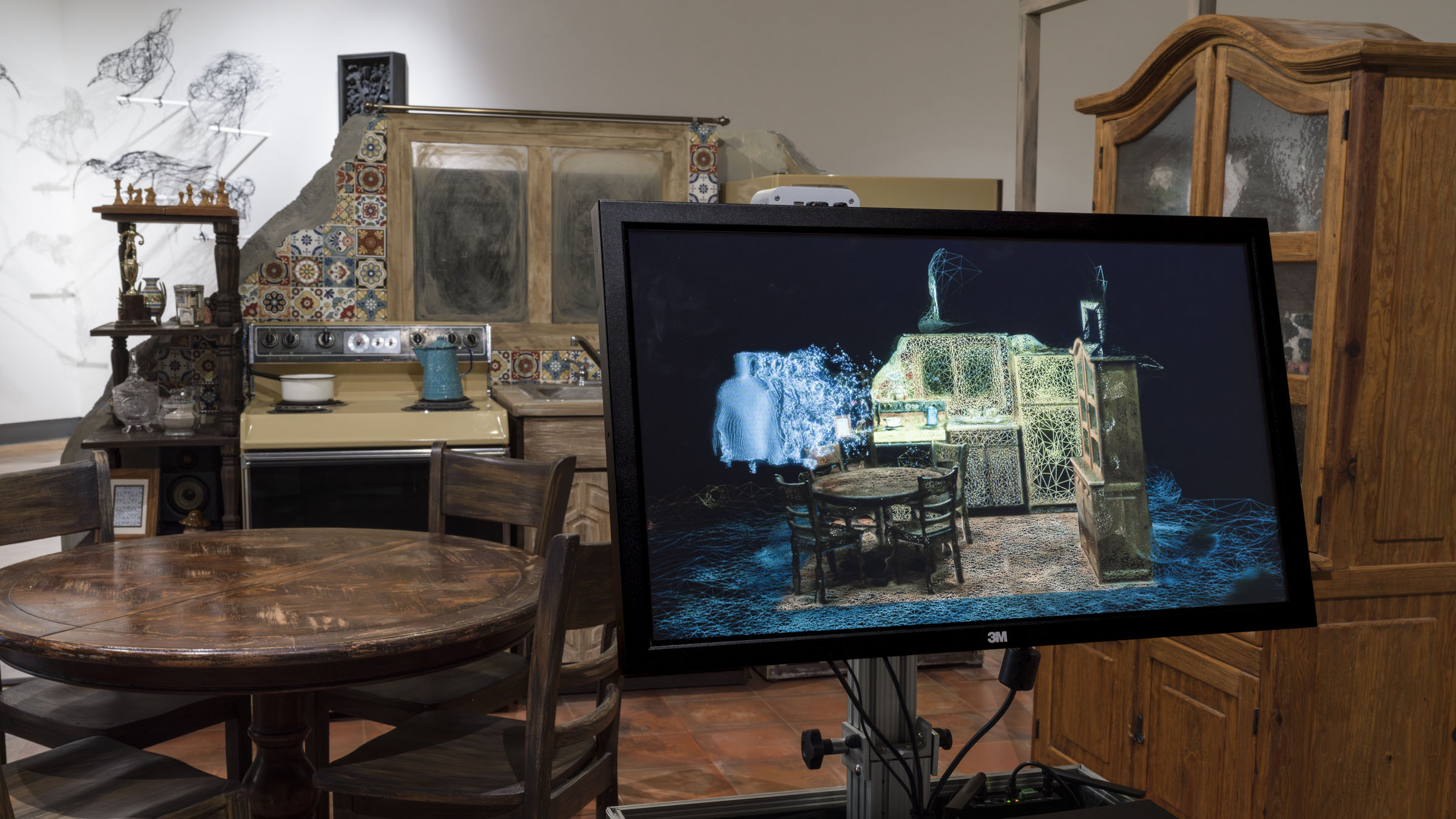
Those memories not only helped shape Caballero as an artist, photographer and researcher, they also became the inspiration for his current MFA Thesis Exhibition installation, “IN PLACE,” at the University of Arizona School of Art. Since 2023, the Fulbright student has participated in 23 exhibitions and screening placements, and secured 21 grants, fellowships and awards.

And his latest honor might be the most impressive: the overall Outstanding Graduate student for the College of Fine Arts. Caballero will be honored May 17 at the 2026 CFA Spring Graduation Convocation in Centennial Hall at 2 p.m.

“Andrés exemplifies the CFA criteria through an uncommon combination of rigorous, research-driven creative work, sustained academic excellence, demonstrated leadership and consistent public-facing community engagement,” Regents Professor Sama Alshaibi said in her nominating letter on behalf of the school’s Photography, Video & Imaging (PVI) faculty.

“Grounded in the U.S./Mexico borderlands, his work examines how computational systems reshape borders, domestic space, and memory, with disproportionate consequences for marginalized communities,” she said.

Border families contribute to MFA project

Caballero’s MFA installation, “IN PLACE,” on view at the University of Arizona Museum of Art until May 16, reconstructs a Mexican family’s dining room from the borderlands. As a video of a participating family re-enacting oral histories and everyday domestic gestures plays, a real-time computer vision system quietly tracks the audience’s movement, shifting the room from refuge to a monitored space.

“These everyday scenes, such as sharing a meal, offer a powerful entry point for empathy,” Caballero said. “They reflect the human need for community, stability and care. In doing so, the work reclaims visibility for those often rendered invisible, reminding us that migration is not only about crossing borders, but also about preserving dignity, connection and a sense of place.”

He worked with five families, four from Douglas and one from Tucson, with much of his design work based on continuous visits and conversations, in addition to personal objects they contributed for his final installation.

“This process included the collection of oral histories, which culminated in recorded reenactments of personal memories. These recordings are what the audience sees on one of the screens,” Caballero said. “The relationships I built and the experiences I had during this process remain some of the most meaningful moments of my time here.”

Bringing visibility to school

As far as “meaningful moments,” Caballero has had many during his three years at the School of Art:

Academic: In addition to his Fulbright scholarship and a 3.94 GPA, his other major distinctions include the Marcia Grand Centennial Sculpture Award, the Border Arts Corridor (BAC) Fellowship; the Mellon Fronteridades Graduate Fellowship from the Confluencenter for Creative Inquiry; and a Tinker Field Research Grant. He also became the first School of Art MFA student to receive a Roots for Resilience Fellowship from the University of Arizona’s Data Science Institute, an honor typically held by PhD candidates.

Creative activity: His “Borderlands Masks” solo exhibition at the school’s Lionel Rombach Gallery explored the stories of the lucha libre community along the US-Mexico border. But his student work reached well beyond the usual graduate exhibition circuit, including major cultural and civic venues such as the Tucson Museum of Art (“Ya Hecho: Readymade in the Borderlands”), the Consulate of Mexico in Tucson, the 17 Days Video Series at Western Michigan University, and presentations in Guadalajara and Mexico City, demonstrating professional traction and cross-border visibility.

Leadership: Caballero served on the Latin American Art Patrons board and the Sienna Collective, supporting students of all backgrounds and lived experiences, and was active in the school’s Riso club. He also created a professional opportunity for five PVI graduate students by securing a grant from the Graduate and Professional Student Council to support attendance at the Society for Photographic Education 2025 National Conference. He shared advanced technical knowledge through workshops and invited presentations such as “Computer Vision & Vibe Coding,” hosted at the School of Art. He excelled as a graduate teaching assistant, including lab sessions for Intro to Photographic Practices, and as a graduate research assistant to Alshaibi and Associate Dean David Taylor, and as a digital production assistant in the U of A Libraries’ Digitization Services for Special Collections.

Community Outreach: Caballero has hosted public-facing workshops and invited presentations, including the “Documenting the Desert” workshop (Douglas, Arizona), the Computer Vision & Vibe Coding workshop (VARS, Tucson), and an invited presentation for the Tinker Field Symposium (Kiva Theater, Tucson). He also has supported public screenings and events that brought university-linked creative research into civic, binational and community spaces, including projects and presentations at venues such as the Consulate of Mexico in Tucson and community arts sites in the borderlands.

“He brings visibility to the program through media coverage and public storytelling, extending the reach of student research and strengthening the public profile of the School of Art,” Alshaibi said.

MFA project continues his focus on community

In his research, Caballero said he seeks a bilateral and collaborative approach, “where everyone is an active participant in the construction of a border counter-narrative.”

“My goal is to continue strengthening these community ties to generate art that serves as a tool for agency in the face of increasing systems of control,” he said.

As part of his Centennial Prize award, Caballero plans to make his MFA “IN PLACE” installation a traveling exhibition shown in different cities throughout the borderlands, prioritizing public, non-institutional spaces. He’s in the final stages of discussion to show it at a historic public venue in Douglas. “This would be a special location for me because most of the participants from this project live in the area, so I am imagining it as a community pop-up event,” he said.

In addition, Caballero hopes to gather enough documentation to build a comprehensive website for “IN PLACE.” He said: “Beyond serving as a living digital archive, the site will allow the project to reach a wider audience,” he said. “It also becomes a public, open-access resource that exists beyond the institutional walls.”

Looking back and ahead

Caballero credits Professors Alshaibi, Martina Shenal, Taylor and Marcos Serafim — and his Photo, Video & Imaging MFA cohort — for helping him achieve his goals. His first class, Experimental Photographic Techniques with Shenal, set the tone.

“I was delayed a week due to some visa issues, so my first introduction to them was by having my face projected into a huge wall while I could barely see anybody,” Caballero said. “After I finally arrived, I felt welcomed right away and quickly bonded with everyone. At that point, I was experimenting freely, just learning and following my curiosity. That lack of pressure made the experience feel completely liberating.”

He added: “I still remember the time spent in the darkroom with my peers; working through ideas, talking about their processes, and trying to figure out what I wanted to say with my own work. Those moments became meaningful throughout the program.”

As for his career aspirations, Caballero plans to return to Mexico City at some point and apply to PhD programs in Studio Art, both in the United States and internationally. “My research is currently focused on new media and experimental visual arts, and I plan to continue developing projects in this field while eventually teaching courses related to these areas in my country,” he said.

“My goal is to continue working as a full-time artist while remaining engaged in an academic environment,” Caballero said.

More stories

I fell down some stairs

I fell down some stairs

Lyle Emmerson Jr.
What Do You See?

What Do You See?

Utvista Galiante
Floral Arrangement

Floral Arrangement

Janessa Southerland
Tailgate Party

Tailgate Party

Roger Masterson
Half Off Special

Half Off Special

Wilbur Dallas Fremont