3 students to present art education research at national conference

Three University of Arizona doctoral students in Art & Visual Culture Education will present their research during the 2026 National Art Education Association Convention in Chicago.

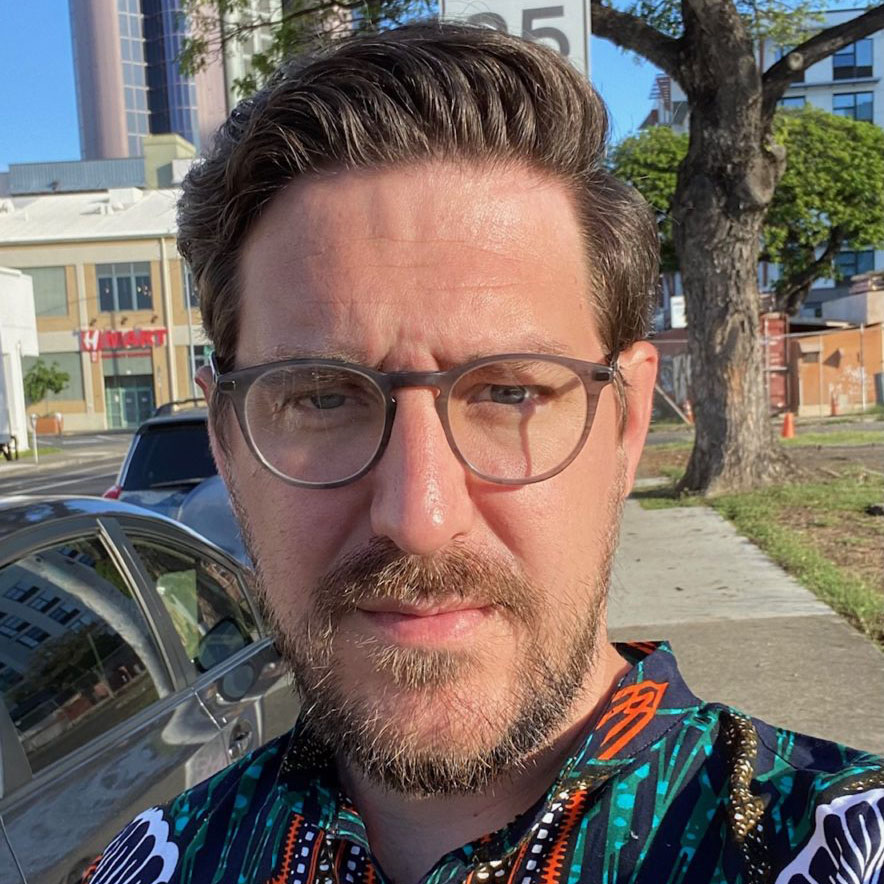
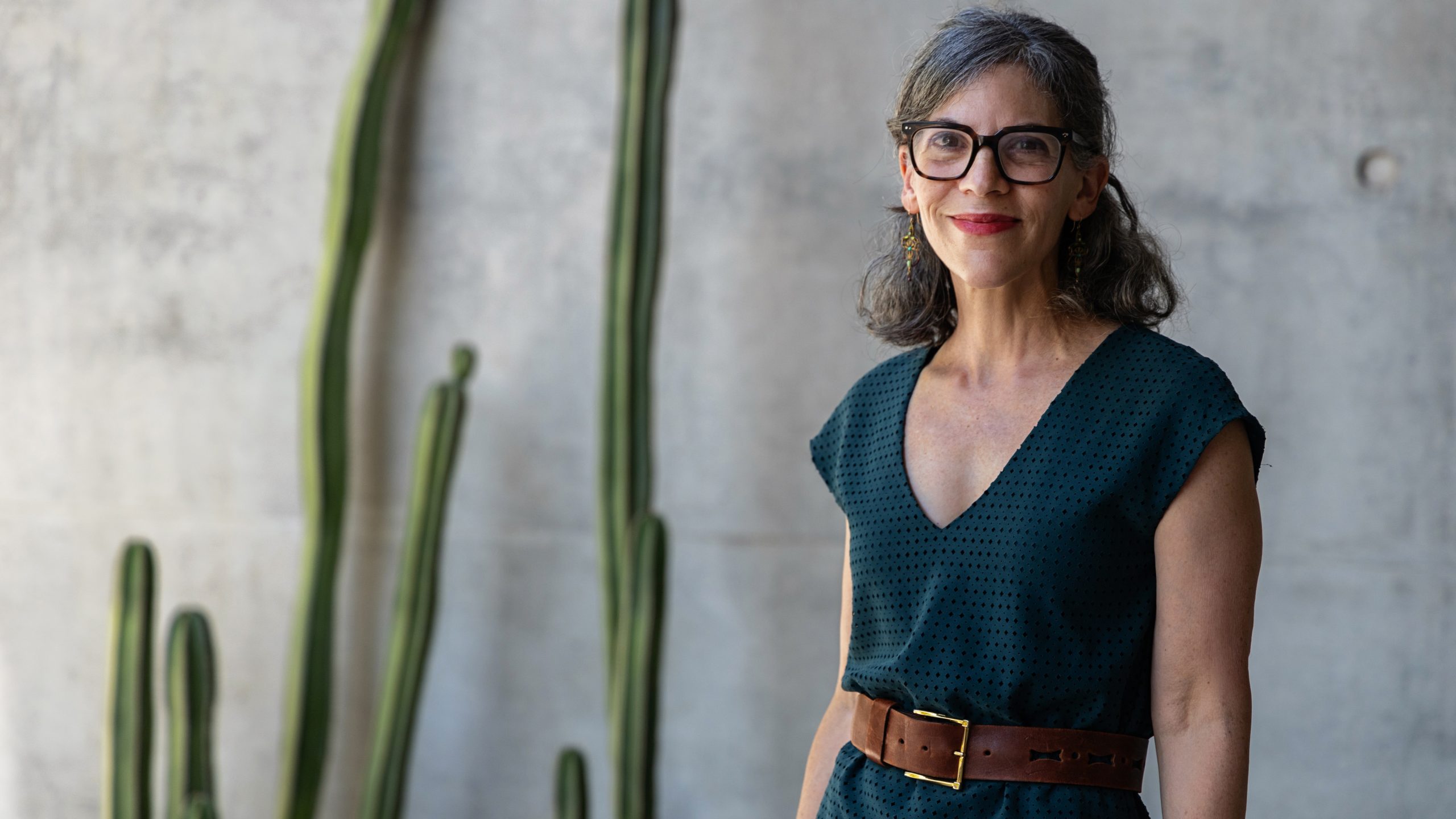
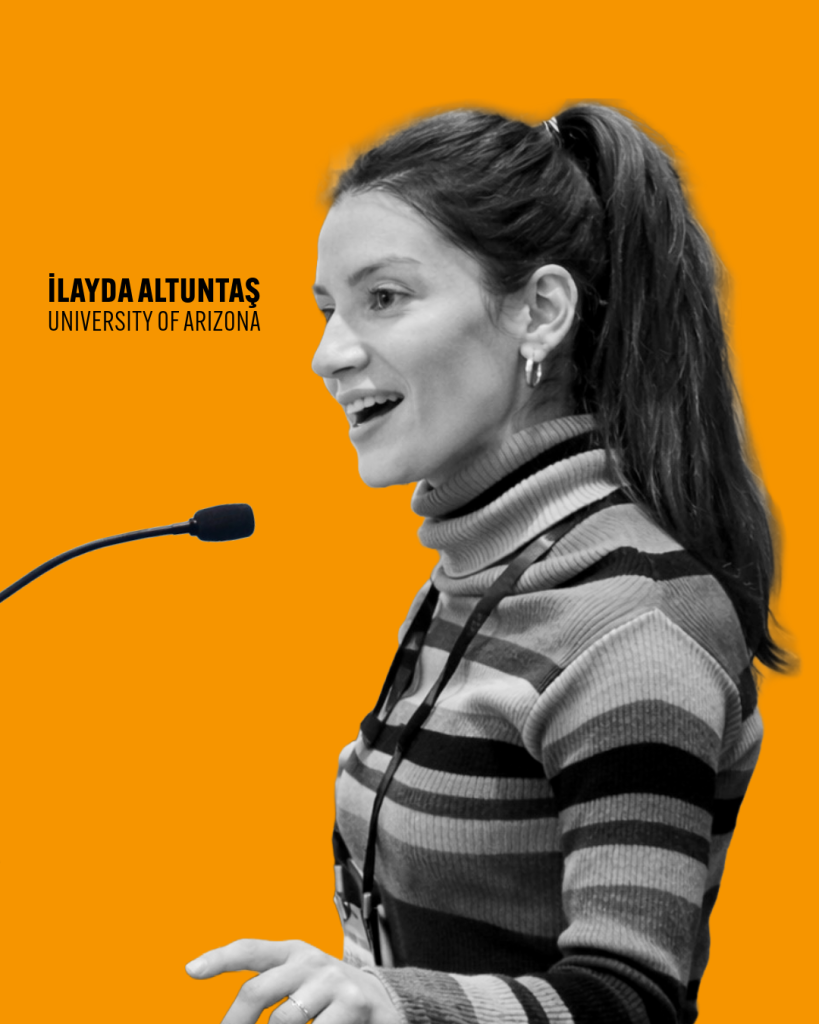
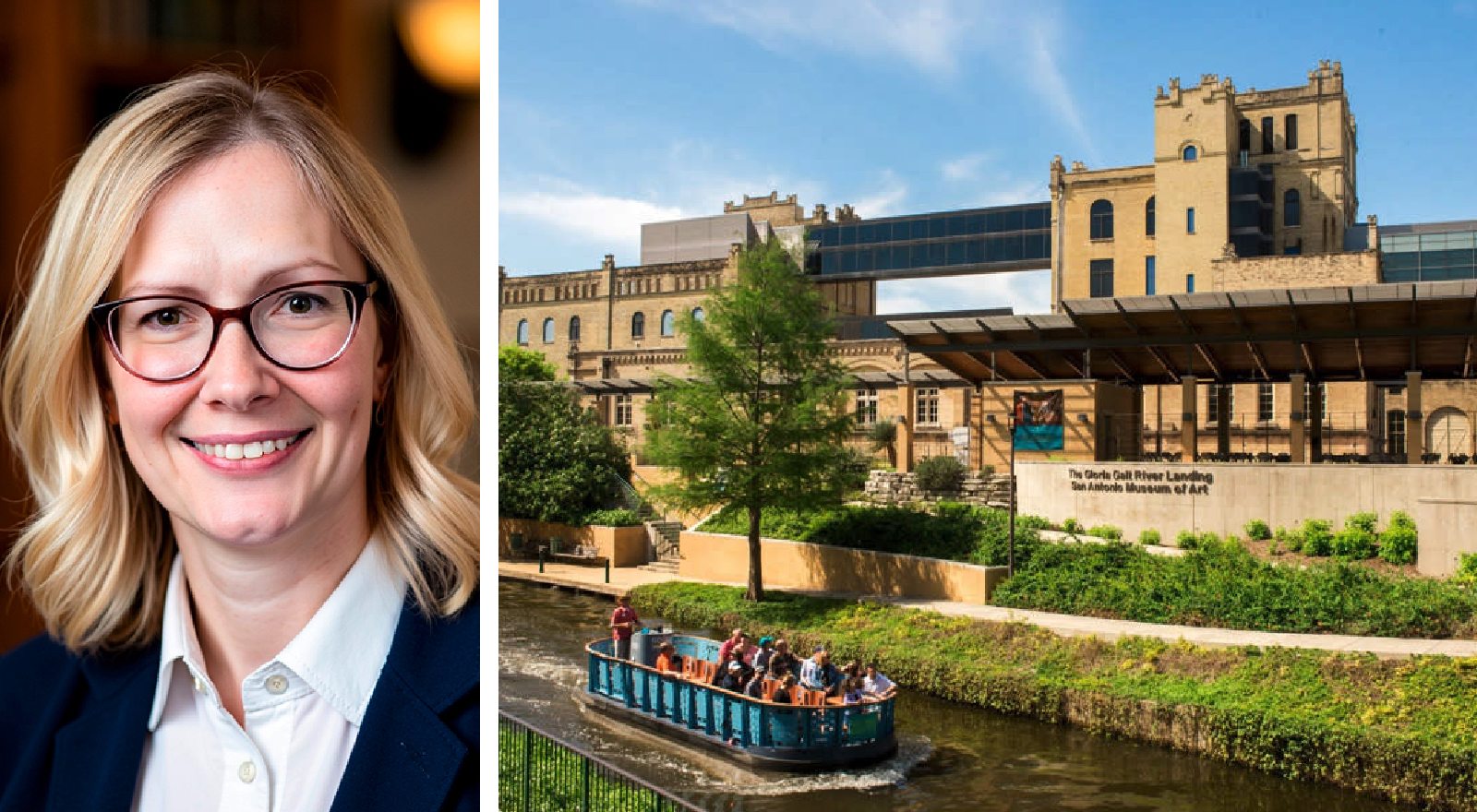
Ziyu Feng, Seoyeon Jenn Kim and Yuqing Wang will join School of Art Assistant Professor Ilayda Altuntas, who will be leading the Seminar for Research in Art Education (SRAE) Interest Group Chairperson’s Panel on March 6.

The panel features Graduate Student Research Lightning Talks — a mentored national session designed to support emerging scholars as they share current research, build professional networks, and engage in conversations about research development, publishing and academic career pathways.

Feng integrates climate data visualization with sustainable handmade papermaking to explore how knowledge emerges through embodied and ecological engagement. Rather than treating climate data as abstract information, her work re-materializes it through tactile processes, positioning fibers, water, environmental forces, and human bodies as active participants in meaning-making. This transdisciplinary approach bridges art and science while foregrounding sustainability and climate education.

Kim will present “From Page to Practice,” which investigates how picturebook pedagogy and arts-based inquiry cultivate critical consciousness in art teacher education, with attention to race-conscious and socioculturally responsive teaching.

Wang will present “Self-Expression and Body Marks: Community-Based Art Practices for Healing and Body Awareness.” Her arts-based research is grounded in embodied epistemology, and during the community engagement portion of the session, she will facilitate a participatory activity connected to relational meaning-making through body marks.

“The Chairperson’s Panel is intentionally structured as a mentorship space where graduate students not only present research, but also connect across institutions and engage with current issues in the field,” Altutnas said. “It reflects SRAE’s long-standing commitment to rigorous, community-oriented scholarship in art education.”

Altuntas will be joined by other School of Art AVCE faculty at the March 5-7 convention, including Professors Amy Kraehe and Ryan Shin and Associate Professor Carissa DiCinido.

Shin and Kraehe will co-present the Invited Studies in Art Education Lecture: “Principled Leadership in Art Education: Understanding and Promoting Change in Teaching, Research and Administration.”

Kraehe will be part of “Sociological Art Education: Methods and Applications for Today,” a panel presentation that takes stock of sociological approaches in art education and gauges interest in a book proposal on critical and reflexive sociological methods used by art education researchers and teachers. Sociological framings may be a useful pivot that keeps art education discourse mobile during trying times.

Kraehe also will participate in “Beyond Binaries: Creative Acts in Precarious Times,” a session that responds to the challenges that art educators experience in their classrooms and communities in these precarious times and the productive ways to navigate art teaching and learning.

From left: Amy Kraehe, Ryan Shin and Carissa DiCindio

Altuntas and Kraehe will be part of the SRAE Business Meeting session: “Networking and Research Advice for Graduate Students and Emerging Scholars.”

Shin will attend the Asian Art and Culture Interest Group executive board meeting and be part of the
Studies in Art Education Panel Session for International Authors. He also will help lead an advisory session, “Writing for Studies in Art Education,” for prospective authors interested in submitting manuscripts for review.

In addition, Shin will be a panel member of the session, “Policy & Action in Difficult Times: Supporting Art Educators’ Diverse Perspectives in Contested Art Educational Contexts.” The panelists will offer strategic policies for inclusive curricula, ethical pedagogies, and advocating for art education programs that address recent challenges to the field.

DiCindio will help present “Centering Critical Consciousness Through Local History, Public Art, and Monuments: Research Commission Sponsored.” She and the panel will discuss public art, local history and social practice to investigate the role of the arts in civic engagement, collective care and advocacy. DiCindio also will be part of the Journal of Social Theory in Art Education Author Roundtable, focusing on the theme of “Movement and Momentum.”

Alumni show highlights school’s photo legacy

For Kaitlyn Jo Smith, the University of Arizona MFA Studio Art program in Photography, Video and Imaging not only “helped build confidence in myself and my voice,” but it also “encouraged me to set big goals and apply for big shows,” she said.

In turn, it was students like Smith and five fellow alums in this month’s “Under the Sun” exhibition at Tucson’s Steinfeld Gallery who helped faculty build the School of Art PVI program into a powerhouse with a No. 3 ranking by U.S. News & World Report behind Yale and UCLA.

“I felt a genuine support and care from my faculty and peers, many of whom I am still friends with today,” said Smith, a 2020 MFA alumna and now a lecturer for the school. “It is this nurturing environment that I try to implement within my own classroom. I want my students to feel safe in the exploration of their identities. I want them to experiment and to push themselves further than they thought they could go.”

Smith and fellow MFA alums Stephanie Burchett (2018), Daniel Cheek (2013), C. E. Fitzgerald (2018) and Serge J-F. Levy (2015) and Jacinda Russell (1999) will hold an opening reception Saturday, March 7, from 4 to 8 p.m. at the Steinfeld Gallery, 101 W. Sixth Street. The exhibition continues until Sunday, March 29, when the photographers will hold a panel discussion at 2 p.m.

Kaitlyn Jo Smith (photo by Julius Schlosburg)

School of Art Professor Emeritus Joseph Labate, curator of “Under the Sun” and a 1986 MFA alum, said the six photographers’ work “has been shaped by study and teaching in the PVI program and reflects a shared commitment to rigorous inquiry, experimentation and critical engagement fostered through university-based photographic education.”

“I am quite proud of the program and my long history in it,” Labate said. “I entered the program as an MFA student and left it as a professor of art. In those early days as a student, I learned of the wide range the medium of photography as art could cover. That extended my previous educational experience and understanding of the medium and showed me the strength of diversity in its practice.” 

Labate stressed that the PVI program’s strength begins with faculty — including current Professors Sama Alshaibi, Martina Shenal and David Taylor, Assistant Professor Marcos Serafim and Smith — “whose art practices may be quite different and distinct from their colleagues, yet they still value and respect what those others do,” he said.

“It’s collegiality with diversity and the ability to work toward a common goal, creating a strong program,” Labate said. “This behavior moves to the graduate and undergraduate students and creates an energetic and safe space in which to practice your art.”

From left: Daniel Cheek, Jacinda Russell, Serge J-F. Levy, Joseph Labate, Stephanie Burchett, Kaitlyn Jo Smith and C. E. Fitzgerald.

It also helps that the internationally recognized Center for Creative Photography is located across Olive Road from the School of Art. “The CCP’s exhibitions, archive, presentations, visiting artists, scholars and opportunities for students are of huge value to the photography program,” Labate said.

In his curator’s statement, he said this month’s group exhibition at Steinfeld not only “highlights a lineage of teaching and learning that has shaped generations of photographers and contributed meaningfully to the field,” but it also is “presented at a time when universities and education in general are under attack.”

“The works on view do not address this political moment directly; rather, the quality and range of their work stand as evidence of what education makes possible: conceptual depth, technical mastery and sustained artistic research,” Labate said.

Here’s a look at the photographers in “Under the Sun”:

Kaitlyn Jo Smith

Bio: Smith’s interdisciplinary studio research examines the socioeconomic impact that emerging technologies have on America’s working class. She is the 2023 recipient of the Alice C. Cole ’42 Fellowship in Studio Art, was longlisted for the 2021 Lumen Prize in Art and Technology (London) and received the College Art Association’s Services to Artists Committee Award for her video Lights Out. Smith has been featured in PDNedu, Art IDEAL, and Al-Tiba9 Magazine. She has presented her work at FEMeeting: Women in Art, Science & Technology (Évora, Taos, and Windsor), Technarte International Conference on Art and Technology (virtual), and Homecoming, Society for Photographic Education Annual National Conference (Denver).

Images she’ll be showing: “A selection from my project ‘Antithesis of a Revelation,’ which was created as a coping mechanism during Covid, the death of both of my grandmothers, my parents’ separation and the loss of my childhood home. While I had been making these images behind the scenes of my public practice for nearly a decade, it did not become clear to me that these photographs come together to tell a larger story of love, loss and acceptance until very recently. ‘Under the Sun’ will be the first time that images from this series will be on display for a larger audience.“

Website: https://www.kaitlynjosmith.com/

Jacinda Russell

Bio: As a conceptual artist with a longstanding interest in edges, borders and topographical extremes, Russell has examined the impacts of human-accelerated climate change in the polar regions since 2017. She works primarily in the mediums of photography, sculpture, installation and bookmaking. Her artwork has been exhibited at numerous locations nationally and internationally, including the southernmost place on earth, the Amundsen-Scott South Pole Station. Born in Idaho, she received her BFA from Boise State University in Studio Art before getting her MFA from Arizona. She currently lives and works in Tucson.

Jacinda Russell (courtesy of jacindarussell.com)

Images she’ll be showing: “My series in the exhibition is titled ‘Art Department, 2013 – present.’ I was born into an Art Department and have spent all but three years of my life there. My father was a painting and drawing professor at Boise State University where, as a child, I watched him grade, helped him rearrange drawing chairs to face the modeling stand, and stared out the windows while he completed administrative tasks. Later, I would attend the same school, switch my major from creative writing to studio art, and enroll in the courses of the professors who had known me since birth. I moved to Tucson for a graduate degree and after seven years as an adjunct instructor, obtained a tenured photography position.

“It was not long before I noticed history repeating itself in the stories my father told and those that I witnessed firsthand. In 2013, I began documenting 66 years in an Art Department from the perspectives of the student and the professor. In Under the Sun, straightforward photographs of the pedagogical environment depict emptiness as a blank slate for creativity, what remains after moving to a new building, an early retirement, a loss of voice, and a resignation.“

How did the program shape her career? “I spent 17 years as an Assistant and Associate Professor at Ball State University in Muncie, Indiana. The professors at UA modeled how I would teach in the future (Harold Jones, Carol Flax, Ken Shorr, Joe Labate, Gayle Wimmer, Ellen McMahon, Barbara Penn, Paul Ivey) as well as nurturing my interests in photography as an object, installation as an art form, and bookmaking — mediums I primarily use to this day.“

Her favorite memories: “All the late night hours spent in front of the color processor. The warehouse studio space off Euclid next to the railroad tracks which smelled like the bread factory. The 30-year friendships. The photo program is special in the way that I am not only close to the people who attended at the same time as me, former mentors, and a handful of students … but I have formed lasting friendships and collaborations with people who graduated long afterward (Camden Hardy through the Postcard Collective, Anh-Thuy Nguyen and Clare Benson were visiting artists at my institution in Indiana, etc.). The element of belonging by association runs deeper than I ever would have thought after graduating in 1999.“

Website: https://jacindarussell.com

Stephanie Burchett

Bio: Burchett is an and educator whose work explores themes of place, identity and environmental infrastructure. She currently serves as the Assistant Chair of the Arts & Humanities Department at Glendale Community College in Arizona, where she teaches photography. Born and raised in Greeley, Colorado, Burchett’s interest in photography began in her youth, inspired by a camera left behind by her grandmother. She pursued a BA in Graphic Arts and Photography from the University of Northern Colorado before earning her MFA in Studio Art from the University of Arizona.

Images she’ll be showing: “A new body of tintype work that documents the tools and makers of Greeley Hat Works, a custom cowboy hat shop in Greeley, Colorado, named Greeley Hat Works. They opened in 1909 and have made custom hats for ranchers and the local community but also for George W. Bush and members of the Yellowstone Cast.“

Her thoughts on the School of Art: “I chose to pursue an MFA so I could teach photography at the college level. The opportunities that I had to teach while pursuing my MFA and working with our faculty who modeled how to balance a life of teaching and making were incredibly valuable. Earning the degree was an essential stepping stone to my current position at Glendale Community College. I am so grateful for the opportunity.“

Her favorite moment at U of A: “Although it’s hard to call it a single memory, one of my favorites is David Taylor’s field research class, which I took during my second year of graduate school. About every two weeks, we would travel to different landmarks throughout the Sonoran Desert. Some of these destinations included San Xavier del Bac, Baboquivari Peak, Ajo, and Pinal Air Park. We camped and spent time together at all hours, traveling, sharing meals, and learning about the local artisans and
communities we visited. I’ll always be grateful for the camaraderie formed with my peers during that experience, and I hold our memories close to my heart.“

Website: https://www.stephanieburchett.com/

Daniel Cheek

Daniel Cheek (courtesy of dancheek.com)

Bio: Cheek’s work examines the ways people experience the world around us. Whether working in national parks or museums or in his neighborhood, he is interested in looking for authentic experiences and the ways we directly interact with our surroundings. His work has been exhibited in galleries and museums across the United States. His work was part of a three-person exhibition titled “Great Basin Exteriors” funded by the National Endowment for the Arts and the Western Arts Federation that was shown in fifteen venues throughout Nevada. Daniel’s work was featured in Denver Art Museum’s “Other People’s Pictures: Gifts from the Robert and Kerstin Adams Collection” as well as in “To Bough and To Bend” at The Frederick R. Weisman Museum of Art at Pepperdine University in 2023. He had a solo exhibition at Andrew Smith Gallery in Tucson in 2022.

Artist statement: “Working in national, state, and local parks, as well as public lands, I am looking at the historic and contemporary ways people travel through and experience the outdoors. I am interested in authentic experiences and the ways we directly interact with our surroundings. I believe that through interpretation of the ways we experience places that are considered natural, we learn more about how we want to live in our own environment. When we want to experience nature, we often drive to the nearest park, when we have made our way past the parking lots and visitor centers, we are guided by trails and signs and guardrails. My work looks at this experience and how these types of things may affect our view of what nature is. Where does nature begin and where does the built environment end? What does it mean to be “out in nature” versus just being outdoors?“

Website: https://www.dancheek.com/

C.E. Fitzgerald

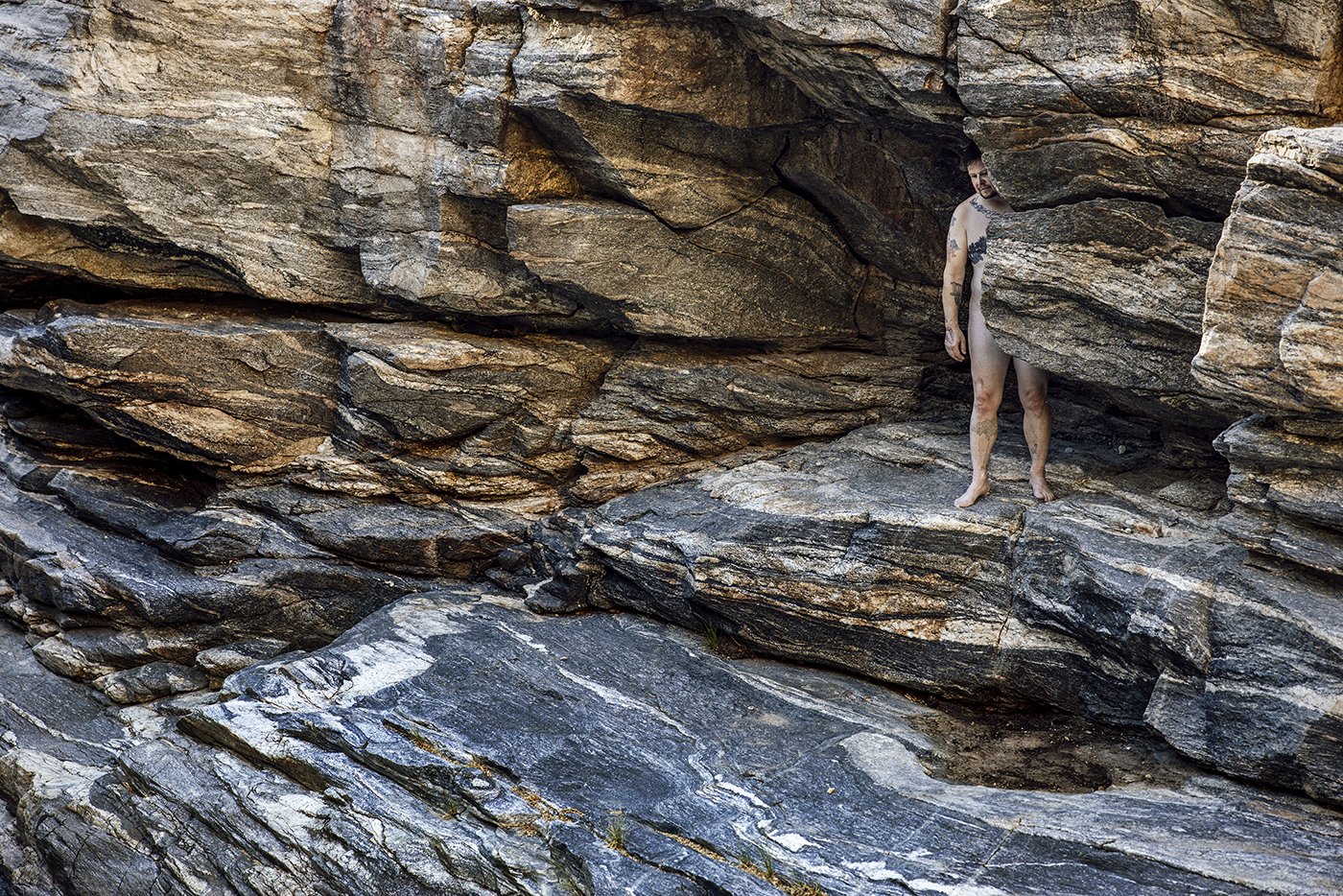
Bio: Fitzgerald is an artist who works primarily in self-portraiture. He often photographs himself in inhospitable environments, where he positions his body in awkward poses. His photographs draw attention in equal parts to place and the body. Fitzgerald grew up in New Mexico and currently resides in Tucson after receiving his MFA in photography from the University of Arizona. His work has been exhibited at the Phoenix Art Museum, the Tucson Museum of Art and the Museum of Contemporary Art in Tucson.

Artist statement: “I never imagined myself making self-portraits. Somewhere along the way that all changed. I placed my camera on a tripod, disrobed and stepped in front of the lens. I think about place more than I think about my body. I am drawn to certain spaces like a moth to a flame, or a naked mole to a cholla. There is an awkwardness to many of my pictures, a distilled version of life reflected back at me. Total desperation. Pure vulnerability. That is what I am aiming for.”

Website: https://cefitzgerald.com/

Serge J-F. Levy

Bio: Levy did his graduate work with Frank Gohlke at the University of Arizona and received his MFA with distinctions. He earned his BA in Sociology from Vassar College. Levy’s limited-edition two-volume book, “The Fire In The Freezer,“ won Special Recognition from the Dorothea Lange/Paul Taylor Prize out of Duke University’s Center for Documentary Studies. In 2022, Levy was part of the show “Chasing Ghosts“ at The Vision Gallery in Chandler, Arizona. In 2021 he had work in the Human/Nature show at the Lishui Museum in China. Serge was a Critical Mass finalist in 2020. That year, he was also selected to participate in the Arizona Biennial at The Tucson Museum of Art. Additionally, Levy has exhibited his photography at the Philadelphia Museum of Art, Galerie Friedrichshain (Berlin), the Phoenix Museum of Art, Schroeder Romero Gallery, and The Leica Gallery (New York City and Tokyo) among many other national and international solo and group exhibitions. Levy, a former newspaper and magazine freelance photographer, runs a consulting business for photographers. He writes essays and articles about photography for various publications. And he works with LensCulture as a reviewer and consultant.

Artist statement: “Veni, Vidi, Flevi (I came, I saw, I wept). If I could step back far enough, I’m sure I could see the earth falling off its axis. There’s no need to measure how many meters a glacier has receded, nor personally witness Texas-sized garbage islands floating in the ocean: I hear fewer birds, I see plants marching toward the poles, and I can smell the brown particulate hovering over the remote horizons I walk upon. Civilization is dying, yet somehow humans persist. With each search, swipe and like, black holes of innovation swallow more pieces of our humanity. Landscape falls in there too; it’s a hungry abyss where nothing is spared. The tea leaves frown upon our future. A world where everything—plant, animal, rock formation—was granted citizenship might be slower: perhaps slow enough to give us the time to adapt to our human mistakes. Yet if we granted plants their rightful personhood, we would realize we are pillorying our people. I hang my head even lower in grief for the injustices imposed upon fellow animate beings who share consciousness and feeling. When I look at how we treat each other, it is no wonder how we treat the non-human world. When I look at how we treat ourselves, it is no wonder how we treat each other. So now I travel to the places where my apologies can be heard, alone, with the citizens of the world I believe in.”

Website: https://www.sergelevy.com/

Alumna Farrar named UAMA director

School of Art alumna Chelsea Farrar has been appointed permanent director of the University of Arizona Museum of Art.

Farrar, who had been interim director for the past four months, received her BFA and MA in Art & Visual Culture Education from the University of Arizona in 2004 and 2013, respectively. As a graduate student, she taught classes for the School of Art. At UAMA, she helped mentor School of Art students through internships and workshops as curator of community engagement and assistant curator of education.

“Chelsea held a steadfast commitment to making UAMA a place where everyone is welcome and feels like they belong,” said Carissa DiCindio, associate professor and chair of the school’s Art & Visual Culture Education program. “For AVCE students, her educational programs and community-based exhibitions are models for what a university art museum can achieve, as both a site for learning and a bridge between the university and the broader Tucson community.

“I am thrilled that she is going to lead UAMA as director and excited to see this next chapter for the museum.”

Chelsea Farrar

Farrar’s work with community engagement has included programs such as Art Sprouts, a story time and art-making event for children ages 3 to 5; and Mapping Q, an art-making workshop series that invites youth ages 14-24 to explore topics centered on the LGBTQIA+ experience — including self-care, community building and harm reduction. She also has curated community-based exhibitions in UAMA’s Our Stories gallery, working with faculty, artist and local groups to amplify underserved artistic voices.

“I am truly honored to step into the role of director at UAMA, a place that has been my home for the past 10 years in academic and community engagement,” Farrar said. “I am excited to continue fostering connections through art and to explore new opportunities for growth, innovation and creative belonging.”

Arizona Arts Dean Hasan Elahi, in announcing Farrar’s promotion, called her “an accomplished arts leader whose extensive experience, institutional knowledge and deep ties to both the university and the broader community make her exceptionally well-suited for this role.”

“Chelsea brings a clear understanding of UAMA’s significance as a resource for interdisciplinary teaching, student engagement and research,” Elahi said. “Her background will further strengthen the connections between the museum and the School of Art.”

Under Farrar’s direction, UAMA reopened to the public on Jan. 17 after with free admission for all. The policy change came after the museum completed installation of a new, state-of-the-art HVAC system.

“This new approach reinforces UAMA’s commitment to accessibility and public service,” Elahi said. “While campus visitors have long enjoyed free entry, extending this privilege to the wider community removes financial barriers and ensures that UAMA can inspire, educate, and connect people from diverse backgrounds. This shift strengthens the museum’s role in the vibrant cultural landscape of Tucson and Southern Arizona, aligning closely with the university’s land-grant mission.”

During her tenure as interim director, Farrar secured multiple gifts totaling over $500,000 in new philanthropic support for UAMA. “Her ability to build authentic, clear, and caring relationships with donors shows her operational fluency and readiness to guide the museum at scale,” Elahi said.

 “Chelsea’s leadership is characterized by integrity, collaboration, and a genuine care for people,” Elahi said. “She has earned the full endorsement of the UAMA staff and has fostered trust across teams through mentorship, accountability and a thoughtful, steady approach to decision-making. Her clear vision for UAMA’s future builds upon existing strengths, positioning the museum for long-term growth and impact.”

Prior to joining UAMA, Farrar taught visual art, art history and theater arts at Amphitheater High School.

Arizona Arts and the University of Arizona Museum of Art contributed to this story.

Anderson Ranch hires MFA graduate Caswell

Austin Caswell, a recent University of Arizona School of Art MFA graduate, has landed a studio technician position in digital fabrication at the prestigious Anderson Ranch Arts Center near Aspen, Colorado.

Austin Caswell

Starting Feb. 16, Caswell will support, maintain and help run the digital fabrication studio, working with workshop participants, artists in residence, and visiting artists and instructors.

Anderson Ranch, established in 1966 in Snowmass Village, Colorado, brings together aspiring and internationally renowned artists to its campus nestled among the Rocky Mountains. Caswell knows the area well. He grew up and attended college in Colorado and still has family there, including his mom in Denver, where he was born.

“I’m thrilled for the opportunity to support such an amazing and storied art center and its participants,” Caswell said. “They just shared their workshop lineup for the summer, and it looks awesome. I’m really fortunate to be in a place where I can come into contact with such a vast array of ideas and processes. The location definitely isn’t bad, either.”

Anderson Ranch Arts Center, 15 minutes from Aspen, Colorado, hosts workshops for aspiring, emerging, established artists, children and teens in seven disciplines: photography & new Media, ceramics, painting & drawing, furniture design & woodworking, sculpture, printmaking and figital fabrication.

Caswell received both a BA in Integrated Visual Studies and a BA in History from Colorado State University before earning his Studio Art MFA in 3D and Extended Media at Arizona in May 2025. He then taught at the School of Art as an adjunct during the fall 2025 semester — drawing on his experience as a graduate teaching assistant.

“I loved my experience teaching at the School of Art,” Caswell said. “Working with students in 3DXM courses and being there to witness their discoveries and successes was really rewarding.”

He also enjoyed his time as a student, including being featured in the 2024 Arizona Biennial at the Tucson Museum of Art, where his installation “The Finder” was a speculative, future archaeological site that used lifespans of plastics to seek meaning and knowledge within lost contexts, including playground slides found around Tucson. The installation won the Biennial’s Pat Mutterer Sculpture and Architecture Award.

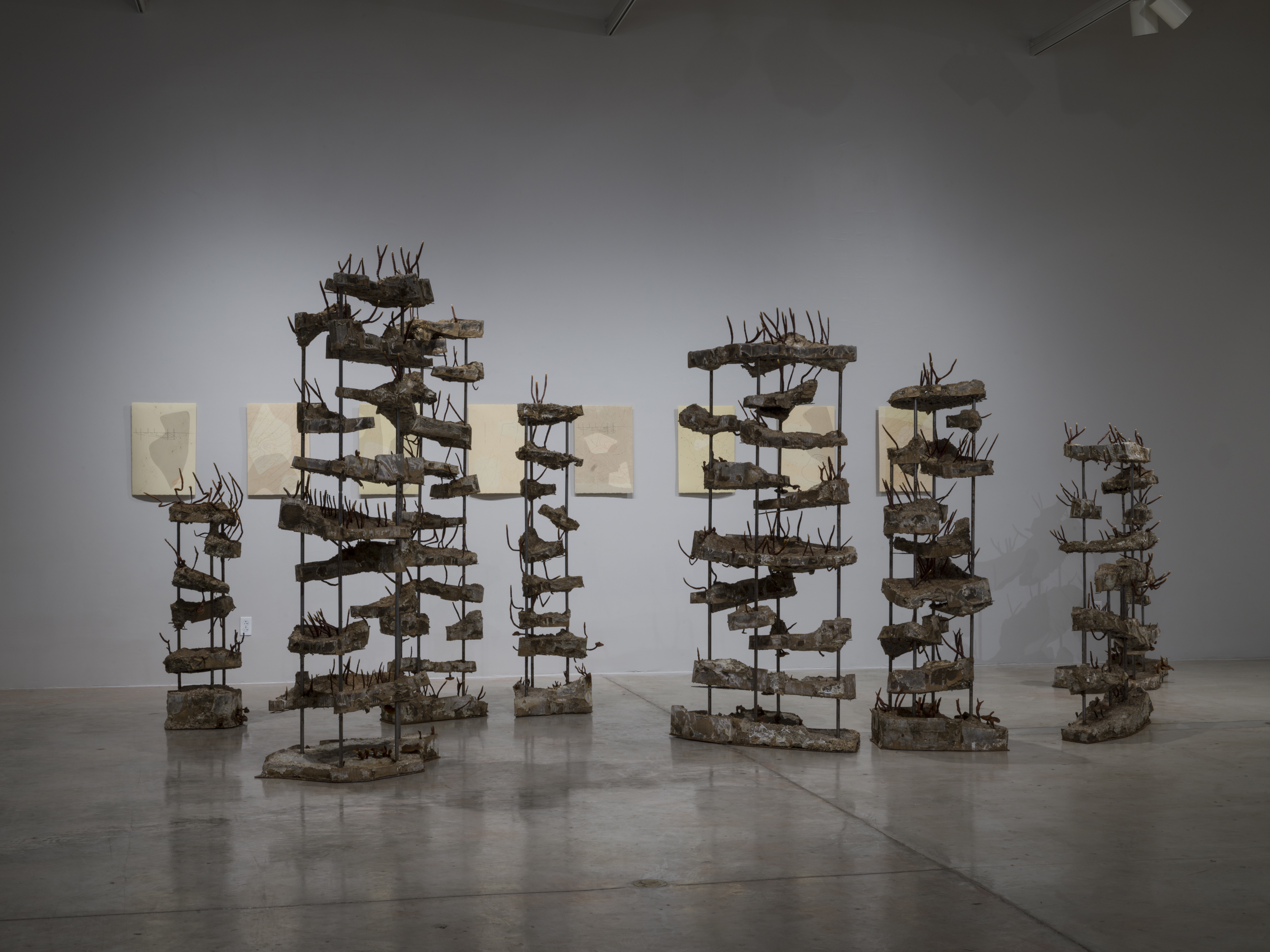
Caswell’s “The Finder” included playground slides found in Tucson, scrap rebar, Palo Verde branches, a shark tooth from Cape Hatteras (N.C.), Nike running shoes found under a bush near campus, a serenity prayer gold chain necklace found in Hollywood, fragments of a dinosaur bone from a dig site in Southern Utah — and an In-N-Out french fry from under his car’s driver seat.

“My MFA gave me the time, feedback and additional resources to develop a stronger foundation in navigating between material processes and conceptual inquiry,” Caswell said, “which I think translates well to supporting artists in a studio environment where they’re working through both technical and creative challenges.”

Calling him “a model student,” Professor Gary Setzer worked closely with Caswell and chaired his MFA thesis exhibition committee.

“Austin has a tireless work ethic and a sharp intellect with a distinctive command of metaphor,” said Setzer, associate director of the School of Art. “His layered and sophisticated approach to content in his artwork stems from his developed scholarly curiosity. And while studio art and history are separate fields, his practice appears to be a unique hybrid that employs strategies from both.”

Caswell’s thesis installation, “The Fault, the Raft, and the Current,” presented a landscape of human stewardship and consumption.

“The Fault, the Raft, and the Current,” by Caswell, featured pine wood sculptures, acrylic paint, medium-density fiberboard, steel, fossil, pearl and fragments of asteroid and flint. (Photo by Alexis Joy Hagestad)

“Austin’s installations address the quandary of human ‘progress,’ and they do so through a nuanced approach that grapples with consumerism — highlighting its necessary evils, its glory, and its long-term impact on our planet,” Setzer said. “Never shying away from the true complexity of what is at hand, Austin’s artworks are as frank as they are guised in a thick and wonderfully bewildering poetry.”

Added Setzer: “Lensed through a distanced and futuristic anthropological look at humanity and our shortsightedness, Austin creates installation-landscapes riddled with the detritus of a people long gone. A future that’s not necessarily apocalyptic — but definitely bleak. A future that’s not necessarily beautiful — but seemingly romantic, nonetheless.

“Austin is a young Caspar David Friedrich for the Anthropocene,” said Setzer, referring to the famous 19th century German Romantic landscape painter.

​Caswell has exhibited across the United States in venues such as the parkeralemán-El Paso Community Foundation in Texas, the Museum of Art- Fort Collins in Colorado and 311 Gallery in Raleigh, North Carolina. He also holds professional experience as a studio instructor, carpenter, landscape designer and fabricator.

Caswell, with University of Arizona President Suresh Garimella and current School of Art Interim Director Karen Zimmermann, during a 2025 MFA Thesis Exhibition reception.

While at Arizona, Caswell was awarded a summer residency at the Haystack Mountain School of Craft in Maine and was a resident at the School of Art’s Lionel Rombach Gallery. He also received the school’s coveted Helen Gross Award, which provided generous funding for his thesis project, and a Medici Scholar travel grant to support his research.

In Caswell’s new role at Anderson Ranch, Setzer said the artist’s supportive teaching methods will help him excel.

“Austin meets people where they are, builds trust, and leads them to new things,” Setzer said. “Wherever there are complications, he sees possibility and problem-solving.”

• Artist’s website: austincaswell.com
• On Instagram: @austinmcaswell

UAMA exhibition, alums honor Doogan

School of Art alumni are remembering Professor Emerita Bailey “Peggy” Doogan as the University of Arizona Museum of Art celebrates the late artist with an exhibition that highlights her life’s work.

In “Bailey Doogan: Ways of Seeing,” on view until April 4, 2026, 80 selections from each phase of Doogan’s career are being displayed together for the first time, highlighting her artistic processes and evolution.

After obtaining a BFA in Illustration from the Moore College of Art and Design in Philadelphia, Doogan began her career as a graphic designer. Among her most well-known designs is the Morton Salt Girl, “Mortie,” an iconic symbol of the brand that remains mostly unchanged today — and one that the artist later reimagined in the large pastel drawing, Pour It On (1998). Her early work shows the influence of her design background, as well as the pressures she faced as a woman in a largely male-dominated industry.

Bailey Doogan self-portrait
Self-Portrait, Fingered I (Chin Finger), Bailey Doogan, 2009, Oil on panel

In 1969, Doogan moved to Tucson to teach graphic design at the University of Arizona. She was promoted to Professor of Design, Painting and Drawing in 1982 after receiving her Master’s in Animated Film from UCLA. Much of Doogan’s 1980s work features bright colors and cartoon-like figures as seen in If You Can Scream Loud Enough You Get Hopp’in Mad (1982).

At the end of the decade she began creating her signature works focused on the human body. Detailed and visceral, these drawings and paintings interrogate traditional artistic conventions of female beauty by centering the aging female body, a subject which has been largely avoided in Western art and popular culture.

In works like RIB (1988-1989) and Self-Exam (2003-2005), Doogan explained she was not aiming to depict “The Nude” or “The Figure.” Rather, “I deal with the real body,” she said. “Our bodies are diaries of our experience. Whatever happens to us is recorded there: wrinkles, scars, the way we stand. That specificity fascinates me. I think it’s beautiful.” Doogan often painted her own body at a monumental size and in great detail, drawing attention to aspects of the female form that society often shies away from.

Doogan retired from the School of Art in 1999 and became a professor emerita of Painting and Drawing. She remained a vital part of Tucson’s arts community and a driving force in the downtown arts scene before her death in July 2022 at age 80.

“With powerful imagery, combining bite and humor, she called out sexism and misogyny in academia as well as in the Tucson art community and the art world,” School of Art Professor Ellen McMahon said in the school’s website obituary for Doogan. McMahon took three classes from Doogan while a graduate student at the University of Arizona.

Other former students remembered Doogan as the UAMA exhibition opened on Jan. 17:

Eve Calderaro
BFA ’98, Studio Art
Art teacher, K-8, New Jersey

Bailey was a painting professor during my time as an art student at UA and I took one of her classes. I remember her very distinctly. She was sharp, sassy and undeniably talented. Her work wasn’t easy to look at and I think that was very much the point. She wasn’t easy … or afraid of being honest in her work and in life. 

She told us about designing the Salty Girl logo in her early graphic design days. To this day, I keep a Salty Girl label pinned at my desk…in my art class where I am an Art teacher myself, K-8 public school in New Jersey.  She made us get custom sheets of glass as our palettes for oil painting and she always told us how she liked the empty jars from her martini olives to clean her brushes. 

As an artist, I take these little pieces with me on the journey and I’m grateful to have had exposure to someone like Peggy Bailey Doogan. I can think of other teachers who were more likeable or supportive in general, but there was a motivating factor and daring that came from Bailey.  She was staring you down and not taking anyone’s excuses.  Challenge accepted, thank you, for being you, exactly as you were.  RIP and I’m so happy to see your life’s work recognized.


Chris Carls
MFA ’98, Studio Art
Art Director, Cirrus Visual, Tucson

Chris Carls

Margaret Bailey “Peggy” Doogan is most famously known as the designer of the Morton Salt Girl, but I remember her as an incredible painter and teacher. She was on my Masters of Fine Arts panel and I had a few classes with her. I was her assistant in the Advanced Painting class my final year, and was also her intern for a summer at the Anderson Ranch Arts School in Snowmass, Colorado. I even worked around her house, helping with various projects. After graduation, I’d visit and take her out to lunch since she lived close to work.

I loved her straight-forward talk. She was a true badass, and one helluva strong lady that would take no $hit. But she always had a precious smile to share.

My favorite line is when she’d suggest painting for your favorite part: “If you did it once, you can do it again.”

She fought for us young and dumb artists. She dedicated her life to helping us grow. She inspired me to want to teach so many years ago.

Thank you, Peggy! Miss you!


Deb Kahn
BFA ’73
Commercial art, Florida

Bailey Doogan was a major influence in my career as I pursued a major in Commercial Art and a minor in Scientific Illustration.

The memory that stands out the most was the time she stopped to talk with me in the hallway. I don’t remember the details, but I do remember the inspiration. It carried me through my lengthy career in Commercial Art.

I understand the title “Ways of Seeing.” I have become legally blind, but still practice my evolving art.


Tricia Amato

Tricia Amato
BFA ’86, Studio Art
MA ’07, Art History
tamato design, Phoenix

Peggy, as she was known then, was teaching graphic design and we were so intimidated by her! But she was an amazing teacher, and something she told me has continued to inspire me.

“There are no bad ideas,” she said. “It’s only the execution that can suck.”

So true!

I also remember her telling us that when she interviewed for her academic position, they asked her if she would start crying in front of the class. This was in the late ’60s.


Mark Fina
BFA ’84, Studio Art
Creative Director, New York City

As a graduate, enthusiastic designer, and artist, I can look back fondly and proudly on the inspiration that Professor Doogan provided for me. She challenged me and instilled in me a drive that propels me every day in my career and creative pursuits. She also ignited the idea of inspiring others, which has led me to become a professor myself. 

Thank you, Professor Doogan. You have given us all so much and enriched our artistic minds, for that we are forever grateful.


Send us your memories of Professor Emerita Doogan at artinfo@cfa.arizona.edu.

Profs Kraehe, Shin join elite art education class

University of Arizona School of Art Professors Amy Kraehe and Ryan Shin have been elected to the National Art Education Association Distinguished Fellows class of 2026 — among only four members nationally chosen for next year’s prestigious award.

“Membership in NAEA Distinguished Fellows is a mark of excellence in art education research and is widely considered one of the highest honors in the field,” Kraehe said. “It serves as a reminder of the opportunities and mentorship I have been given, for which I am immensely grateful.”

Dr. Kraehe and Dr. Shin, part of the school’s Art & Visual Culture Education program, will be honored March 5 at the NAEA national conference in Chicago.

Dr. Amy Kraehe (photo by David R. Randell Photographics)

“This recognition not only celebrates my journey thus far,” Shin said, “but it also inspires me to continue advocating for excellence in art education.”

Kraehe, a national leader and researcher in the arts, culture and education, also was selected to serve a four-year term as a Trustee of the National Art Education Foundation. “We are confident that your experience and perspective will be a valuable addition to the Foundation and will contribute meaningly to advancing (our) mission,” said Chris E. Guenter, the foundation’s past chair, said about Kraehe.

She has 25 years of experience in universities, public schools and museums. She has been a part of the College of Fine Arts since 2018 and was named Associate Vice President for Organizational Excellence and Impact at Arizona Arts in 2025. She received the Excellence in Fundraising Award for her contributions to development and advancement at Arizona Arts and garnered the Women of Impact Award from the University of Arizona for driving discovery, interdisciplinary collaboration, community outcomes and the empowerment of others. 

Her writings, podcasts, public lectures and workshops illuminate how sociocultural, economic, and political contexts influence the development of professional identities and organizational capacity within educational and cultural institutions. Kraehe has published four books, and her work appears in the top research journals in her field. She has received numerous grants and professional honors, including the prestigious Manuel Barkan Memorial Award from the National Art Education Association.

Dr. Ryan Shin

Shin’s research focuses on Asian popular media and culture, Asian critical theory and decolonization, global civic engagement, and new media and visual culture. In 2025, he was elected as associate editor for “Studies in Art Education,” a prime national research journal in the field of art education. He will serve two years as associate editor, and automatically move to editor position of the journal in 2027.

He has co-edited several notable books, including The Intersectionality of Critical Identities in Art Education (InSEA, 2024). In 2021, he was honored as the USSEA Kenneth Marantz Distinguished Fellow. His scholarly articles have been published in renowned journals, and he has authored numerous book chapters and presented his work at both national and international conferences.

“We are thrilled that Professors Kraehe and Shin are receiving this fellowship,” said Professor Karen Zimmermann, interim director for the School of Art. “No one is more deserving of this honor than these two. Their significant contributions to the AVCE program at the University of Arizona and to Art Education nationally and internationally are incredible as mentors, researchers and scholars, teachers and colleagues. We are so lucky to have them as part of our community.”

Top senior Margalit soars as animator, comics editor

For her dedication to animation, illustration and creative storytelling, Sela Margalit has been named the School of Art’s Outstanding Senior for fall 2025.

The Studio Art major carries a near-4.0 grade-point average with a minor in Film & Television and Art History, is a paid intern at Arizona Public Media (AZPM) and helped produce animation projects for Biosphere 2, the Borderlands Restoration Network, Semiconductor USA and AZPM.

Sela Margalit

But Margalit has had the most blast — “no pun intended,” she said — creating her “Atomic Age Adventures” comic strip for the Arizona Daily Wildcat. Since fall 2023, she’s produced over 40 strips in the series, which features Sylvania Spaceray — a modeling-sensation-turned-government-recruited lunar ranger — and Crater the dog carrying out missions on the moon, including trying to outsmart a small alien.

“I think writing comes the easiest when characters feel like real people and I’m just checking in on their lives, which is definitely how I feel about Sylvania Spaceray and Crater the dog,” Margalit said. “So much, that I also made my capstone film, ‘Atomic Age Adventures!’ about them. My favorite recurring character is definitely the alien. I have a hobby interest in alien theory, and he’s just a really funny little guy.”

Her mom encouraged her to join the campus newspaper as a sophomore. “At first I was shy,” Margalit said, but she quickly rose to become comics and illustration editor while mentoring other artists. The confidence she gained led to more successes as Margalit:

  • Worked on “Small Seeds; Big Change,” a Center for University Education Scholarship-supported initiative and class collaboration with Borderlands Restoration Network (BRN), in which she developed a short animation about the Sky Islands ecosystem. The clip was shown at the “What’s Up, Docs?” showcase at The Loft Cinema, where Margalit also participated in a Q&A on stage.
  • Met award-winning documentary filmmaker Lisa Molomot, who hired Margalit to deliver a short animation sequence for Semiconductor U.S.A. to help teens learn how semiconductors work and are part of everyday life.
  • Participated in The Wonder Studio at Biosphere II Summer Residency, where Margalit produced a humorous short about a curious scientific researcher from Mars who investigates the history of biomes at the living laboratory north of Tucson. Following the residency, she curated a short animation program of her fellow residents’ work for First Friday Shorts at The Loft Cinema.
Sela Margalit works in the Daily Wildcat newsroom.

“Sela has sought out every opportunity in animation throughout her degree path and delivered consistently polished, creative, and conceptually impactful work,” School of Art animation Assistant Professor Nicole Antebi said in a nominating letter for the Outstanding Senior Award. “She has also positioned herself as a leader among her peers through her collaborative efforts.”

Last fall, Antebi introduced Margalit to Arizona Public Media producer Andrew Brown, who offered the student an internship with Arizona Illustrated in spring 2025.

“Sela worked successfully with our producers across a variety of projects that have helped us tell more engaging and dynamic stories and better serve our audience,” Brown said. “She has a good work ethic, is professional and easy to communicate with and takes direction well.”

Following the internship, Margalit became AZPM’s first paid student intern in animation. She contributed a key sequence to the story, “Eveli: The Algerian Born Jeweler of the Southwest” — a collaboration with Antebi’s animation class and another “high-stakes professional opportunity with a public-facing audience,” Antebi said. “Once again, Sela delivered strong, visually compelling, and polished work.”

Said Margalit: “When Eveli producer Özlem Özgür reached out to me about how she wanted more animation to be woven through the piece, I was ecstatic. It was a bit daunting as it was more animation than you typically do in the class, but with my film background I gained knowledge of editing and was able to pull it together quickly.”

In addition, Margalit pulled together her 4-minute animated senior capstone project for the spring 2025 BFA Capstone Show in Illustration, Design & Animation, despite an ambitious timeline. She “held auditions for voice talent, storyboarded the entire piece, animated and colored it, added audio, and had everything finished before the end of the semester,” adjunct instructor Valentin Mancha said.

Sela Margalit’s self-portrait drawing

“I’ve had memorable moments with so many of my professors,” Margalit said. “Professor Antebi really showed me the breadth of possibilities in animation, as well as offered constructive critique for my technical skills and advice about animation as a real career. I was unsure of design at first, but Prof. Watanabe made design both fun and actually digestible. Lastly … Prof. Mancha believed that I could finish my ambitious capstone and went out of his way to connect me with the resources and feedback I needed.”

Born in Los Angeles, Margalit moved to Tucson later in her childhood. “Being around a lot of art museums and media in L.A. “led me to having a passion for the arts,” she said. “Furthermore, my mom showed me so many different books, TV shows, movies — both educational and entertaining — that really ignited a spark for storytelling and creativity. I loved animated content from Cartoon Network, PBS Kids, and Disney, as well as comic books (especially X-Men).”

All those experiences helped her excel at the School of Art and with the campus newspaper.

“The Daily Wildcat is truly my home on campus,” Margalit said. “Coming into the comics desk, it was a great opportunity, but I wondered how it could be better. With the support of my fellow student members, as well as our advisor Susan McMillan, the comics desk has grown so much and I’ve had the opportunity to guide so many artists in creating their work, both in comics and editorial illustrations.

“Making art that supports the journalistic work the paper does is so important,” she said, “but it is also awesome that the completely creative pursuit of comics also has a place in the Daily Wildcat.”

Sela Margalit designed a van wrap for the Daily Wildcat.

As for the future, “I feel like being open to any creative opportunity is crucial,” Margalit said. “I’m planning on staying in town for a while and continuing to seek out as many opportunities as I can while promoting my work and continuing to develop my portfolio skills. I plan to do freelance work, try to participate in local events and keep integrated in the community.”

In her recent Halloween comic strip for the Wildcat, Margalit’s Sylvania Spaceray creates a lunar latte for Crater the dog, similar to a pumpkin latte. Crater doesn’t like it, calling it “dirt in a cup,” and Slyvania admits, “I didn’t say it was going to be good.”

For Margalit, though, even Crater the dog would agree that her future looks bright.

“Sela’s consistent determination, forward-thinking, and ability to creatively perform at a high level will ensure that she will make a significant impact wherever her career takes her,” Antebi said. “Through her numerous successful collaborations and the positions mentioned here, Sela has already taken the first steps in positioning herself on a strong career trajectory.”

Slide Image
Slide Image
Slide Image
Slide Image
Prev Next

Macias charms Cheech, others with art and teaching

Alejandro Macias felt a mix of nerves and pride as he introduced his work to actor and Chicano art collector Cheech Marin at a recent exhibition opening. Then Marin smiled and told him something unexpected: He’d dreamed about one of Macias’ paintings the night before.

“I’ll go ahead and take that as a good sign that I’m doing something correctly,” the University of Arizona associate professor said with a laugh.

Macias has been honored for doing a lot of things correctly since joining the School of Art faculty in 2019 as a painting and drawing teacher — including an Arizona Higher Education Award and multiple residencies, fellowships, grants and other awards. The New York Times even used his “American Mexican” painting as a supporting image to Pulitzer-winning opinion writer Carlos Lozada’s Oct. 20 essay, “You Caught Me. I’m Speaking Spanish.”

Alejandro Macias, with his three paintings in “Soy de Tejas” at the Cheech Center: (from left): “Man on Fire (III),” “Ascension III” and “Turning Point.”

So far this year, Macias has presented work in six group exhibitions, including “Soy de Tejas: A Statewide Survey of Latinx Art” at the Cheech Marin Center for Chicano Art & Culture in Riverside, California. It features nearly 40 Chicano and Latinx artists from across Texas and the borderlands like Macias, who was raised near the Mexico border in Brownsville, Texas.

Macias is exhibiting three self-portrait paintings in the show, including the one Marin dreamed about, “Turning Point” — featuring a video loop of Macias’ own navigation across the desert terrain in Mesa, Arizona — along with “Man on Fire (III)” and “Ascension III.”

“I described my work to Cheech as an exploration of identity, assimilation and place,” Macias said, “particularly how the U.S.–Mexico border continues to shape the lives, bodies and narratives of those connected to it.”

Marin rose to fame in the 1970s, ’80s and ’90s as part of the comedy duo Cheech & Chong, the television series “Nash Bridges” and the movie “Tin Cup,” filmed in Tubac and Tucson. He established “The Cheech” in 2022 with the Riverside Art Museum as the first North American facility dedicated exclusively to Mexican American and Chicano art — donating his collection of over 700 pieces.

“Meeting Cheech Marin was definitely surreal because I had an opportunity to speak about my work on such a personal level to a cultural icon,” Macias said. “Because he’s such a passionate art collector, he was deeply invested in what the artists had to say.”

Marin did a walk-through with 25 artists in early October, spending several minutes with each.

“Cheech Marin (left) has built a lasting legacy that has supported a lineage of important Chicano artists for decades.”
Alejandro Macias

“Meeting (Macias and) so many talented artists in ‘Soy de Tejas’ was inspiring,” Marin said. “Each one offered a unique perspective on what it means to be connected to Texas and to identity. I was especially struck by the emotional honesty that runs through all of the works.”

That honesty is what sets Macias’ work apart, according to one of his former students, Vanessa Saavedra, a 2025 MFA graduate and now a School of Art adjunct instructor who took over Macias’ painting and drawing classes this semester while he’s on sabbatical.

“His work is visually pleasing, but the content can be challenging or uncomfortable for the viewer,” Saavedra said. “Alex isn’t afraid of criticism or rejection, and that fearlessness is incredibly inspiring. It’s powerful to see someone so grounded in their beliefs and so committed to expressing them for the greater good.”

Macias draws from his personal and regional histories in the borderlands to explore themes of assimilation and migration. His practice integrates traditional rendering, abstraction and multimedia approaches, using the human figure — often himself — as a central point of his works.

“These remain challenging times, but I do still believe that art has the power to foster dialogue, empathy, and understanding, even if the progress seems to be incremental,” Macias said. “My hope is that the work continues to offer a more nuanced, humanized view of the border experience, countering the harmful rhetoric and narratives that often dominate the mainstream. Having hope is the first step and I have plenty of it.” 

Local exhibition has university ties

He and Saavedra are part of a group exhibition at the Tucson Desert Art Museum, “Cruzando La Línea: Contemporary Art in the Borderlands,” through June 27, 2026, alongside School of Art Professor David Taylor and Professor Emeritus Alfred Quiroz.

Alejandro Macias saw his “American Mexican” painting used as a supporting image in New York Times columnist Carlos Lozada’s Oct. 20 essay, “You Caught Me. I’m Speaking Spanish.”

“We all have a connection to the University of Arizona as either educators or former students, and it feels special to be part of such an esteemed group that has contributed to important local and national conversations about the tensions and complexity of border life,” Macias said. His work in the show stems from his 2024 solo exhibition, “Land of Wolves,” at New York City’s LatchKey Gallery, where he held “a mirror to Border Patrol agents of Mexican descent who have surveilled the borderlands” he said.

Taylor, who is also associate dean of Faculty Affairs for the College of Fine Arts and a 2008 Guggenheim Fellow in photography, has seen Macias’ influence in and out of the classroom.

“Since joining the School of Art, Alex has been an outstanding colleague and teacher,” Taylor said. “His studio practice, which is deeply reflective of both his first-person expertise and research program, complicates and expands upon Latinx representation. Working across painting, drawing and multimedia, his output is innovative while also acknowledging a legible set of influences.”

Saavedra, who grew up in Nogales, Sonora, also received her BFA from the School of Art. She was one of Macias’ first students when he started teaching at Arizona. He also mentored her in Saavedra’s MFA thesis year and hooded her at graduation in May, which Macias called “one of the most significant and important professional moments of my life.”

“Now that both Alex and the university have trusted me to cover his classes during his sabbatical, I can see things from the other side — perhaps how he once saw me — and that makes me even more appreciative of his patience with my process and trajectory,” she said.

Saavedra’s work in the Tucson Desert Art Museum exhibition highlights the complexities of migration and cultural intersection. With her paintings and drawings, she also gives voice to the silenced lives of women across Latin America.

Vanessa Saavedra (center) received support from faculty members Alejandro Macias and Jennifer Saracino at her MFA graduation in May 2025. Saavedra and Macias started at the School of Art in 2019, with Saavedra as an undergrad in Studio Art.

“It’s incredibly fulfilling to see Vanessa contribute to our art community through her own practice,” Macias said. “Her work is meticulous, profound, and is already making an impact in such a short amount of time. … To see her grow in the span of six years makes you realize how important higher education can be.”

Teaching honor ‘means a lot

Not only did Macias participate in the University of Arizona’s 2024-25 Research Leadership Institute cohort, but he also was honored in late September for his commitment to teaching and mentorship in receiving the Alberto “Tito” Rios Outstanding Literary/Arts Award at the Arizona Higher Education Awards in Tempe.

“Being recognized by peers and institutions that understand the intersection of art, education and community engagement means a lot to me,” Macias said. “I found the whole (Tempe) ceremony to be incredibly overwhelming and emotional because I shared space with educators who dedicated their lives to sharing knowledge with others.”

Through Nov. 29, he’s sharing another space at Tucson’s Etherton Gallery with School of Art Professor Lawrence Gipe and MFA alum Jim Waid. Macias’ solo show, “In the Cases,” includes a variety of drawings and mixed media works from 2017-2025, mostly figurative and on paper, that explore his ongoing interest on the border as “a physical and psychological construct,” Macias said. He added that presenting with Gipe and Waid “has been inspiring, and both artists bring decades of experience and visual language that have contributed to the Tucson community” and elsewhere.

During his sabbatical, Macias is focused on developing new work for more exhibitions, including projects that further integrate painting with video documentation and installation. He’s part of a group exhibition, “The Armor We Wear,” at 516 Arts in Albuquerque, New Mexico, curated by Olivia Amaya Ortiz, a 2018 School of Art BFA graduate. The show, which also includes 2018 BFA alumna Elizabeth Denneau, runs from Nov. 8 to Jan 31.

“My work will continue to explore themes of culture, migration and belonging,” Macias said, “but in a more intimate approach that respectfully documents the lives of people who contribute to their border communities.”

Alejandro Macias received the Alberto “Tito” Rios Outstanding Literary/Arts Award from the Pete C. Garcia Victoria Foundation at the Arizona Higher Education Awards in Tempe.

Meanwhile, his paintings will stay on display at the Cheech Center through Jan. 11. Macias’ work also was included in the first two iterations of “Soy de Tejas” in San Antonio and Fort Worth, Texas. He has high praise for the exhibition’s curator, Rigoberto Luna, whose exhibition explores migration, indigeneity, race, gender and mythmaking, while also celebrating the joy, resilience and traditions that define Latinx communities.

“Rigoberto has been building bridges across the coasts of the United States to recognize and uplift artists on a national level,” Macias said. “It’s honestly history in the making.”

Since 2019, Macias has presented his work in at least 65 selected exhibitions across the nation, including six with Luna as a curator. Macias participated in the 2024 Texas Biennial at Sawyer Yards in Houston, the 2024 Border Biennial at the El Paso Museum of Art and the 2023 Arizona Biennial at the Tucson Museum of Art. In 2023, he was the recipient of the Lehmann Emerging Artist award, which included a two-person exhibition at the Phoenix Art Museum. He’s held solo shows at Louise Hopkins Underwood Center for the Arts in Lubbock, Texas; Presa House Gallery in San Antonio; Tucson Museum of Art; and LatchKey in New York.

Macias’ work is included in the permanent collections of the Newark Museum of Art, Phoenix Art Museum, El Paso Museum of Art, University of Arizona Museum of Art (which acquired his first “Man on Fire” painting), Tucson Museum of Art, Mexic-Arte Museum and the Brownsville (Texas) Museum of Art. He participated in notable residencies at Elizabeth Murray in Troy, New York; Vermont Studio Center; Chateau d’Orquevaux in France, Studios at MASS MoCA, Wassaic (N.Y.) Project, CALA Alliance in Phoenix and Uncool Artist in Brooklyn, New York.

“The accolades Alex’s work has received are a clear indication of its significance,” Taylor said. “It’s been a pleasure to see his art career flourish, and we are enormously fortunate to have his influence and mentorship in our program.” 

When Macias returns to the Arizona campus in spring 2026, he can’t wait “to bring these new experiences and perspectives back to the classroom … and to continue guiding students as they find their own voices and purpose as artists,” he said. And in the summer, he will be a workshop instructor in mixed media portraits at North Carolina’s prestigious Penland School of Craft.

“Teaching remains one of the most rewarding parts of my career,” Macias said. “My students’ energy and curiosity constantly reinvigorate my practice and desire to share everything I can.”

Alum Krafft releases film ‘Ain’t Got Time to Die’

Shortly after Martin Krafft received his MFA in Photography, Video & Imaging from the University of Arizona School of Art, he headed to Montana and joined a hiking group through Facebook.

That’s where the filmmaker and social practice artist met Rachel Heysham, a free-spirited, young grandmother who had relocated to Missoula to start a new life out of her RV, only to learn her cancer had returned and doctors told her she had two months to live.

It was the summer of 2020. As the nation began to grapple with COVID-19, the two decided to make a documentary together — “her, in the hopes that she would survive and be an inspiration to people with cancer; me, because I was drawn to her enormous will to live,” Krafft said.

Martin Krafft

He began sleeping on Heysham’s RV couch, driving her to hiking trails, hot springs and doctor’s appointments, and fundraising for her living expenses. Filming took them from Montana to her hometown in Lawrenceville, Pennsylvania — where she had survived abuse, addiction, illness and poverty — to Kansas, back to Montana and finally again to Lawrenceville, where Heysham died in November 2022. She was only 47.

Krafft pressed on and finished the documentary, “Ain’t Got Time to Die.” His 67-minute film, edited by Emma Thatcher, won or took finalist honors at several festivals in the U.S. and abroad in 2024. With the festival run mostly done, he “got tired of waiting to be able to share the film with folks” and decided to release it to the public this year through Eventive, an online streaming platform dedicated to making independent films more accessible to audiences. 

“When I was making the film, I was so caught up in being present with Rachel that I did not have much capacity to think about the life of the documentary after it was made,” Krafft said. “I just knew I had to make it. I was very glad to be able to show Rachel about two-thirds of the film. It was hard for her to watch, but she felt seen by it, understood and appreciated for who she was, without having to be anyone else.”

Rachel Heysham

Early in “Ain’t Got Time to Die,” he asks Heysham how she wants to be seen. “As a fighter,” she says. “As a survivor.” The documentary follows the highs and lows of navigating medical care with a terminal illness. (Heysham tells Krafft she was first diagnosed with squamous cell carcinoma when she was 32 and had her cervix removed.) Despite debilitating pain, she rallies to go on adventures, such as hiking barefoot up mountains alongside her part-wolf puppy and kayaking.

For Krafft, though, being her medical advocate becomes a challenge, and the film looks candidly at their conflicts over her skepticism of conventional medicine and Heysham’s arguments with her daughter, Alisha. He counters the sadness with moments of levity and joy — showing heartfelt interactions between Heysham and her grandchildren and dogs.

“Now that the film is publicly available, I have to do the hard work of getting it out into the world,” Krafft said. “Everyone who I’ve gotten feedback from — family, friends and strangers — are deeply moved by it. Everyone sees how much Rachel wanted to live and are deeply moved by that.”

Social practice background

Bringing strangers into his filmmaking and art is important to Krafft. Based in Schwenksville, Pennsylvania, he works as a stone mason and community and political organizer and runs Red Rock Rabbit Ranch, an artist residency that supports housing insecure artists.

Inspired by his Quaker practice, he uses video, photography, social practice, sculpture and writing to explore boundaries of “otherness” and share people’s voices not often heard in the media, he said. Krafft has worked in a Catholic Worker house serving the unhoused and Death Row inmates, as an inner-city teacher’s aide, as an alternative preschool teacher and as a nonviolence facilitator.

“Because of these experiences, I’ve interacted deeply with many different kinds of people, seen them in difficult situations,” said Krafft, who received his undergraduate degree in creative writing and economics at Emory University in Atlanta. “That’s taught me to be open to people who are different from me, to try to approach our differences with curiosity and compassion. And whenever that effort fails, to have the humility to learn from incongruities.”

Krafft invited the public to trace photographs of people who lost their lives to gun violence in 2017 on the U of A Mall.

While at the University of Arizona, he and fellow MFA graduate Elena Makansi held a 2018 interactive art exhibit, “A Memorial for Past and Potential Gun Victims,” at the Lionel Rombach Gallery. They invited participants to trace photographs of people who lost their lives to gun violence, with the option to hang the tracings on a wall for others to see. Krafft and Makansi held a similar exhibit — “Who Will Be Next?” — on the U of A Mall in 2017 and in Rochester, New York, in 2023.

Krafft and Makansi also created “Traces,” a sculpture memorial for the 2019 Pima County victims of gun violence as part of the 2019 Marcia Grand Centennial Sculpture Award prize. They traced the 204 names and or faces of those who had been lost.

During the 2020 presidential campaign, Krafft hitchhiked across the country, accepting rides from both Trump and liberal supporters and interviewing them. He weaved together their videos for a website titled “Cassandra 2020,” with help from his Quaker community.

MFA program ‘got me up to speed’

Krafft made what he called his first “documentary-ish film” in a video class with School of Art Regents Professor Sama Alshaibi.

“Even though I was the only one making documentary work, Sama has a really good ability to see what you’re trying to make, what its strengths are, and where it needs to go,” he said. “(Now retired Professor) Joseph Labate and (Professor) Martina Shenal in the photo department were also very helpful. Beverly Seckinger, a professor in the School of Theatre, Film and Television, let me sit in on her documentary class.”

Krafft’s 2020 MFA thesis project, “matriarch,” reflected upon the death of his grandmother and how his family went “about mourning and recalibrating our relationships in her absence.” Centered around a three-part experimental documentary of the same name, the installation also featured a photo book with writing, chairs, a corner cupboard holding her purse and a poem — and a wall print made from one of her water-damaged photos.

Martin Kraft’s MFA thesis installation, “matriarch”

“I was coming to the Studio Art MFA degree from a writing background. I still used that writing, narrative perspective in my work, but the MFA got me up to speed on what was happening in the art world, what kind of questions were being asked,” Krafft said. “One of the most important questions for artists to sit with is who is making the work, and how does that identity shape what they are seeing.”

What advice does he have for School of Art students wanting to follow in his footsteps?

“For anyone who wants to make a film, I would say just get started,” Krafft said. “I didn’t have a nice camera when I started shooting ‘Ain’t Got Time to Die.’ And the footage wasn’t that great, and the sound was terrible. But it was enough to put me in the world of the film and realize how committed I was to the project, which prompted me to upgrade my gear and be able to use it better on the fly.”

Krafft also said students should heed a message from his old Emory University photography professor, Jason Francisco: “If you want to be an artist, you do it because you have to do it. No one will understand or validate that choice.”

Future projects

Continuing to take Francisco’s advice, Krafft said he’s working on a documentary, “Grampy’s Red Rock Rabbit Ranch,” about the farmhouse where he’s been living in Pennsylvania with his grandfather.

“I was lucky enough to make this film with my friend, a very talented filmmaker, Laura Asherman, so that made it much easier to create than ‘Ain’t Got time to Die.’ We just got to picture lock and will start applying to film festivals in a couple months,” Krafft said.

“I’m also finishing up a video essay on a socially engaged art project called, “Poetry for Strangers,” in which I recited a Rilke poem 1,000 times to strangers throughout Berlin.”

In the meantime, Krafft hopes more people will watch “Ain’t Got Time to Die” now that it’s on a streaming platform.

“As far as a message that I want the film to convey, it’s difficult to reduce to one,” he said, “but maybe the most important one would be an invitation for viewers to channel Rachel’s curiosity for the unknown.”

That message shines through late in the film, when Heysham’s granddaughter Amanda tells Krafft why she wants to be like her grandma:

“Because she explores.”

‘Ain’t Got Time to Die’ 2024 Awards

  • Nawada International Film Festival. Best Documentary Winner. Nawada, India
  • West Kortright Center Film Festival. Best Picture, Best Documentary Winner. West Kortright Center. East Meredith, New York
  • We Make Movies International Film Festival. Best Picture Finalist. Los Angeles
  • Lake County Film Festival. Best Picture Finalist. Lake Forest, Illinois
  • Southern Maryland Film Festival. Audience Award Winner, Jury Award Finalist. California, Maryland
  • Northeast Pennsylvania Film Festival. Best Documentary Finalist. Waverly, Pennsylvania

Etherton show features Art profs, alum

University of Arizona School of Art faculty members Lawrence Gipe and Alejandro Macias and MFA alum Jim Waid are presenting their artwork at Tucson’s Etherton Gallery from Sept. 23 to Nov. 29.

The opening reception is scheduled Saturday, Sept. 27, from 7 to 10 p.m. at the gallery, 340 S. Convent Ave. A look at the group exhibition:

Lawrence Gipe

Professor, Painting & Drawing
Exhibition title: “Casbah Noir”

In his words: “My latest suite of paintings are derived from screenshots I take from my computer while researching films. Just after World War II, for about 10 years until 1955, Hollywood became enthralled with setting their movies in exotic French colonial contexts, especially North Africa. Starting around 1946, they began to replay the formula of Casablanca over and over in a sub-genre that I call Casbah Noir. My intention with this series is to investigate Hollywood’s role in creating stereotypes that persist in our country’s current perception of that region.

Lawrence Gipe, “Casbah Noir: Study No. 3 (left) and Study No. 2, 2025

Etherton says: “Lawrence has created a powerful series of paintings that slow the cinematic tempo to reveal the ideological foundations of colonialism embedded in the seductive language of film noir. In these films the Casbah becomes a metaphor for otherness, unknowability, and eroticized danger. Casbah Noir asks how Hollywood’s cinematic myths continue to shape cultural memory and political ideology today.”

Alejandro Macias

Associate Professor, Painting & Drawing
Exhibition title: “In the Cases”

In his words: “My work is mostly figure-based, and I use the figure as a way to respond to my own identity, but also social-political concerns related to the borderlands. In the show, you’ll see a variety of works spanning from like 2018 until 2025. Most of the work will be on paper. I’m interested in paper because of its durability and versatility. I’m interested in like graphite drawing because of its formal qualities, its immediacy, the fact that I can think about like technical aspects of the drawing but also abstract it. … I wanted to point out some of the work because of its color. I’m interested in the serape for its connection to my own Mexican American identity and the way I can also abstract color. And I’m also like interested in paper and in the fact that I can like mount it on panel and I can include a variety of media like found objects and like wood and collage as a way to further abstract the figure, and that it acts as a metaphor as well for my own identity.”

Alejandro Macias, “In the Cases,” Out of Sight (Conceal) II (left) and Self-Portrait (Serape), 2025

Etherton says: “We’re over the moon to be exhibiting “In the Cases.” … Raised along the U.S.-Mexico border in Brownsville, Texas, Macias draws from personal and regional histories to explore themes of assimilation, migration and cultural hybridity. His practice integrates traditional rendering, abstraction, and multimedia approaches, often using the human figure as a central point of his practice.”

Jim Waid

MFA ’71, Painting & Art History, University of Arizona
Exhibition title: “In stars”

In his words: “I chose my title because the In starts are like the intermediate stages of the insect as they’re growing, and each one metamorphoses into a different form. And then finally the caterpillar or the butterfly arrives. And I think of that as having a resonance with the way I paint, because things are always transforming and moving into something else, evolving into something else. And until it reaches that final state, we don’t know what it’s going to look like.”

Jim Waid, “Instars” (2017)

Etherton says: “Jim is widely regarded as one of Arizona’s most significant painters. For over five decades, he has created stunning, abstract landscapes that translate the desert into densely layered, color-saturated compositions.”

Artist’s websites

I fell down some stairs

I fell down some stairs

Lyle Emmerson Jr.
What Do You See?

What Do You See?

Utvista Galiante
Tailgate Party

Tailgate Party

Roger Masterson
Floral Arrangement

Floral Arrangement

Janessa Southerland
Half Off Special

Half Off Special

Wilbur Dallas Fremont